Pages

Showing posts with label persecution. Show all posts

Friday, June 20, 2014

A Spiritual Legacy

Mass Rock in Clara, County Offaly

Today is the feast of the Blessed Irish Martyrs. I usually write a post on them because their witness is so important to us in these times. Our diocese has one Blessed among them, Blessed Margaret Bermingham Ball.  These Irish men and women, most of them living in Ireland, but a few living in England, preferred to accept death rather than renounce their Catholic faith. They represent many thousands of Irish who put their religion before king, state and society, and who went out into the wild places to meet for Holy Mass, protected priests and passed on the faith to their children even as the state was doing its best to indoctrinate them.

These forefathers and foremothers leave us an important spiritual legacy. It is one of fidelity, endurance, heroism and authentic devotion. All of these are symbolised by physical reminders of our penal past - the Mass Rocks which are scattered throughout the island. One of the most impressive (in my view) is in my home parish, just a mile or so from where my family lives. This Mass Rock (pictured above) is hidden away in the hills of Kilnabin and no doubt holds may secrets as it witnessed, for many years, our ancestors gathered for Mass at the risk of their lives.

This Mass Rock seems rooted in the Irish soil and in Irish hearts, and it consoles me that yet even today the faith is still rooted in the hearts of many Irish men and women. We may well face again what our ancestors once faced, we may not be as numerous, but the legacy of our martyrs and our faithful ancestors, whose names are no longer remembered, can serve as an encouragement for us. At the end of the day we can lose everything the world thinks important - our livelihood, our buildings, our reputations, even our freedom, but we will still share in the treasure of the Church and it can enrich us - faith. Our martyrs teach us how important that inheritance is.

Tuesday, June 10, 2014

Are We On The Brink Of Persecution Again?

In a landmark development Denmark's parliament has voted through a law which will make it mandatory for the Danish church (Lutheran) to conduct same sex marriages (see the Daily Telegraph for details). While individual ministers can refuse on grounds of conscience, the bishops/ do not have the same luxury and will have to appoint a replacement priest or minister to carry out the ceremony. While this refers only to the Lutheran church at the moment, one wonders if individual Danes will seek to have the legislation extended to all churches.  That said this may be the beginning, should we expect other parliaments in other countries to follow suit, particularly in the EU where "consensus" demands all constituent countries fall into line on liberal issues? 

Fr Ray Blake in his blog wonders if the Church in Denmark will be able to hold out, should this happen - it is a valid question. Given the militancy we have seen around the issue of same sex marriage we can be sure there will be incredible pressure applied to the Church in Denmark now that this victory has been given to them and the historical realist in me leads me to expect that that pressure may well turn violent, as it often has in the past. Are we about to see the expected persecution begin, first in Denmark and then throughout Europe?

Time to pray and to reflect on previous persecutions. And let us pray especially for our bishops - they of all people have to remain firm. We can expect individual priests to flout Christian teaching, but our bishops must not.  The statue of St John Fisher on my desk reminds me that at times bishops can be the weakest of men when courage is needed to defy king, president, government and parliament.

Of course in this matter the Danish parliament is overstepping its competence. It has no right to decide what churches do when it comes to marriages, to do so, as it has done, is an act of interference in the belief system of the various religions in Denmark. In terms of Catholicism, if the Danish parliament should seek to extend the legislation, the Danes would be dictating to us how our sacramental system must work. Surely this would be a breach of the separation of Church and State? 

Also, in demanding that churches abandon Christian teaching on marriage, the parliament is ultimately dictating to God, whose teaching we follow, how he must view marriage. The Danish parliament has no right to tell God that he has to obey an act of the legislature, that is why this law is not only unjust it is also arrogant and the height of lunacy. And if we note the lessons in Scripture we see that such presumption usually ends in disaster not for God or for his faithful, but for the ones who tried to force him to adopt their way of thinking and their way of living.

That said, true compassion, which we as disciples of Christ must adhere to, is rooted in truth - in the truth of God's law, in the truth of who we are as human beings, in the truth of what leads to salvation and what hinders it.

Tuesday, April 8, 2014

Here We Go Again...

Eyes wide open: St John Fisher


There are stormy times ahead, and like St Thomas More we Christians will not be allowed to live out our lives in silence tolerating what is going on around us.  There will be no room for dissent, not even silent, unexpressed, hidden away in the ghettos dissent. 

And, I think, as Fr Dwight suggests, the apostles, the shepherds may well be asleep, and perhaps some are may even be encouraging us all to snooze.  Where's John Fisher?

Thursday, December 5, 2013

Galway University's Affront To Free Speech

UL and NUIG in research alliance with Silicon Valley start-up
 
In his recent memoir, Race With The Devil, academic and writer Joseph Pearce, in recounting the story of his conversion from militant right wing activist to Catholic, cites one incident as highly influential in his conversion.   Following what he saw as a breach of his human rights he approached the National Council for Civil Liberties (NCCL) the British equivalent of the ACLU, to seek advice.  As an extreme right-wing activist he believed the NCCL was nothing more than a left-wing liberal organisation interested only in pushing its own libertarian agenda, but he was willing to give it a go.  To his surprise the man who agreed to listen to him was Jewish and to Pearce's surprise, he was willing to take the case.  Why a Jewish man would seek to defend a little fascist intrigued Pearce - it seemed the man was really interested in human rights.  However, Pearce's initial view of the NCCL was correct, the man was overruled by the NCCL - they would not take on the case.  To Pearce's astonishment the Jewish man resigned in protest.  Why?  Because, using Voltaire famous words: he did not like what Pearce said, but he was willing to defend to the death his right to say it.
 
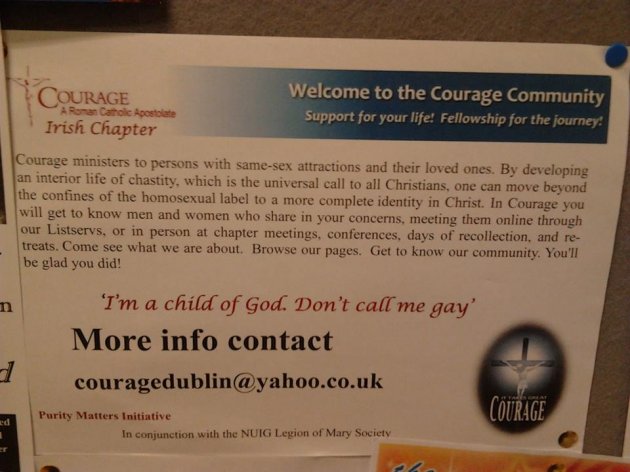
Well, such noble sentiments are rare in the modern, secular world where intolerance and censure has become the norm for those who hold values that challenge the prevailing ideology. And today we have example of this as an Irish University suspends a Catholic organisation because people do not agree with society's defence of purity.  The National University of Ireland at Galway (formerly UCG) has suspended the college branch of the Legion of Mary because the Legion was promoting chastity within the context of homosexuality.  It claims that in doing so it is protecting the liberty and equality of all students. 

It seems the Legion praesidium on campus was merely promoting what the Catholic Church teaches with regard to all people, even those with same-sex attraction: chastity and purity according to one's state in life.  To see this as an option for those with same-sex attraction seems to be interpreted as discrimination.  I note that the phrase which caused most offence to those who made the complaint against the Legion was one which promoted "an interior life of chastity" - that, my friends, is considered to be "homophobic" by the folks over in NUIG. 
 
I am a graduate of the National University of Ireland (NUIM), and to be honest I am very disappointed with this action by NUIG.  In fact I see it as an assault on liberty and equality.  In reality those who have suspended the Legion are seeking to silence opinions they do not agree with and for that the university deserves condemnation.  Those in the university who have issued this diktat are a disgrace, they have committed an affront to academic freedom and the right to free speech. 
 
Free speech is not about allowing/permitting/promoting those opinions we agree with, it is about tolerating those we do not agree with, no matter how much those opinions offend us.   Of all places, one would expect an academic institution to understand this.  Sadly, given that our universities are now monolithic with regard to ideology, for the most part, there is little tolerance for other voices.  Universities seemed to have moved from places where independent thinking was encouraged to institutions for the indoctrination of future generations in a particular left-wing libertarian ideology. 
 
I notice, however, as revealed in another article, the Legion was working in conjunction with Courage Ireland, a noble organisation that works with same-sex attracted people and helps them to live chaste lives in accordance with Christ's teaching and the teaching of the Church.  It has had considerable success in this area, and for this reason it is despised by militant homosexual groups.  Courage in Ireland is doing great work, but it has to operate way below the radar because Irish gay militants have tried to infiltrate and destroy the groups.  It may well be that it was the Legion's promoting Courage that infuriated certain individuals.   The Legion is often ignored by ideologues and regarded by some as a harmless clatter of old fashioned simpletons (anything but!), but perhaps an alliance with an effective pastoral initiative was too much for some over in NUIG.  Perhaps the problem was not discrimination, but rather the real possibility that some people might actually listen to what the Legion and Courage had to say, and in the current ideological climate that is not permissible.
 
image
 
In this action the NUIG is not protecting the liberty and equality of all students, it is cossetting the prejudices of a particular group.  There are those who believe homosexuality is normal and they want to be free to live such a lifestyle, and then there are those who believe otherwise and are willing to meet and work with homosexuals who are disillusioned with the gay life and agenda: if we are supposed to be tolerant and mature, why promote the gay group and persecute the other?  No, the university's decision is not about liberty and equality, it is about silencing people who do not adhere to the new orthodoxy of sexual libertarianism.
 
If you wish to make your views known to UNIG, you can contact the president: Dr James J Browne, President, National University of Ireland Galway, University Road, Galway, Ireland.  Telephone: 00 353 (0)91 524411.

Monday, November 4, 2013

Providence Strikes Again

 
On All Saints' Day I mentioned the little "Saint's Lottery" we have here in the parish, and how it has been spiritually rewarding for some of our parishioners.   Providence seems to be at work and the Lord is reminding us, as he does, of what the Saints mean for the Church and the faithful.  Last year I drew out my own foundress, St Teresa of Avila, this year I drew out a Beata who really surprised me.  Praying to her and about her in the last few days I see God is teaching me an important lesson at this time.  Can I share?
 
My Patron for this year is Blessed Victoire Rasoamanarivo.  You may not have heard of her: I had, but knew little about her.  For one thing I am still struggling to say her second name - nearly there.  She is Madagascar's first Beata and she was elevated to the altars by Blessed John Paul II in 1989.
 
Blessed Victoire was born in 1848 in the capital city of Antananarivo.  She was a member of one of  the noble families of Madagascar.  Her mother was the daughter of the chief minister to the queen, her father was the brother of the commander-in-chief of the army.  Her father died when she was young and her father's brother became head of the household and had an important role in raising his niece.  The religion of her childhood was the native animist religion which also has a strong element of ancestor worship.  Christianity was struggling on the island, and during Victoire's childhood there had been a terrible persecution in which many Christians had been martyred.
 
Around 1861 Victoire first meet the Sisters of St Joseph of Cluny, she was sent to study at their school and here she encountered Catholicism at first hand.  Observing the simple, devout life of the sisters and learning of Jesus she was converted and sought baptism.  Her family were horrified, but despite their efforts to stop her, Victoire was baptised when she was fifteen years old.  Her family threatened her with expulsion and told her that she could not be buried with her ancestors in the family tomb - the ultimate act of excommunication in Malagasy society.  Victoire was not worried: "The missionaries will bury me with them", she replied.
 
Not long after her conversion she was given in marriage to the eldest son of the prime minister.  She was not keen - she wanted to consecrate her life to Christ in the religious life, though the missionaries had advised her that things were dangerous enough because of her conversion, becoming a sister would make things worse for her and Christians on the island.  She decided to remain a laywoman and live the Gospel in the world.  Her husband, Radriaka, was a boorish creature.  He was unfaithful, rough, a drunkard and an abuser.  He continually attacked her verbally for her adherence to the Christian faith, joining his voice with many in Madagascar and at court who were scandalised by her Catholicism.  She endured all these thanks to an intense life of prayer and service of others.  As the years passed hearts were changed as Victoire, always serene, joyful and kind, emerged a woman who was willing to help others and could give very sound and wise advice.  Her marriage disturbed many and she was advised, even by the queen, to divorce her husband because of his scandalous life.  She refused: she was bound to him by the sacrament of marriage - she had managed to convince him to marry her in the Church.  Besides, she said, how would it look if Madagascar's most prominent Catholic divorced her husband?   Victoire's endurance bore fruit: she converted her husband just before he died.
 
In 1883 another persecution broke out and Catholic priests and religious were expelled from Madagascar.  Before they left the Jesuit missionaries entrusted the tiny Catholic population to Victoire's care, and for three years she guided and protected the faithful, encouraging them to come to church for prayers every Sunday and to continue their catechetical formation and virtuous lives.  Of all the trials she suffered in what would be three years of intense persecution, the greatest pain for Victoire was the absence of the Blessed Sacrament.  When the missionaries and priests were allowed to return they found the Catholics to be vibrant in faith. 
 
Victoire' last years were spent in prayer, voluntary poverty and helping the poor and the sick, particularly the lepers on the island.  She was held in deep esteem by all, Christian and animist alike.  She died on the 21st August 1894 after a brief illness.  She was buried in her family tomb, but in 1961 her remains were transferred to the missionaries' cemetery; and then at her beatification her remains were entombed in a chapel dedicated to her in front of the country's Catholic cathedral.
 
Blessed Victoire was a source of consolation to her fellow Catholics in a time of great suffering.  She herself endured many trials, meeting them with serenity, prayer and joy.  Whenever people came to her almost overcome by the trial inflicted on Catholics she said: "Have trust in God!"  And here is the lesson for me, and for all of us Catholics at this time.  We live in a time when our deeply held beliefs are not just tested, but mocked, attacked and even becoming criminal as immoral laws are enforced.  Here in Ireland more legislative acts are being introduced to the parliament which are repugnant not only to our Christian faith but also to basic, reasoning humanity.  How do we cope?  How we endure?  When we are tempted to give up, how we overcome this temptation?  We listen to Victoire: "Have trust in God!  
 
As a priest called to teach the faith and strengthen the faith of my brothers and sisters, Blessed Victoire seems to me to be a powerful intercessor and friend.  She loved the priesthood, assisted priests and offered her prayers and sacrifices to help her priests in their trials.  I do sense providence in her being given as a patron for this year, and I suspect, well beyond.   So if you are willing, please say a prayer for us priests today, and perhaps invoke Blessed Victoire for us.  May she watch over all of us in our time of need and in these times of trial.

Wednesday, October 9, 2013

Something For The Long Winter Nights

 
Well, the winter is coming, and with the prospect of dark evening we might be thinking of some books to read.  If there is one thing the Year of Faith teaches us it is the necessity of reading and learning about our faith.  I haven't written a post on good books to read in a while (if I have ever!), so I thought I might do so as a few new books have caught my attention and they may well be worth reading.
 
The first has to be John Allen's new book, The Global War On Christians.   Intrigued by a conversation with Cardinal Dolan in 2009, Allen went off to do some research on the present persecution of Christians.  He uncovered some startling facts.  It seems, for example, that in the first decade of the 21st century eleven Christians were being martyred every hour.   It seems to be a fact that Christianity is the world's most persecuted religion, some of it being carried out by Muslims and some by secularists in the West.  For more information on this book see CNA's interview with the author.   And here is an article by Allen on the subject of his book.
 
Another book which has caught my attention, and one I have ordered, is Ben Urwand's The Collaboration: Hollywood's Pact with Hitler.  The Alive! newspaper here in Ireland did a review of the book (see page 10) and it was this review which caught my interest.  Hitler, the Nazis and the Second World War continue to fascinate, and every year new books are published about the various figures and examining various dimensions of that awful period.  According to the author Hollywood executives collaborated with the Nazi regime in the 1930s, shaping movies to meet Nazi propaganda roles.  It is well known that various figures in the US and elsewhere had deep admiration for Hitler and given that Hitler was, at the start, improving the plight of many Germans and rebuilding the country that admiration may be understandable in part.  Though Hitler's ideology was loathsome, some will put such things aside for pragmatic reasons - human beings have often endorsed dreadful things to achieve certain goals as we have seen all too clearly here in Ireland in recent times.
 
Apparently Urwand details how Hollywood executives persecuted Jewish employees in order to curry favour with the Nazis.  Now I have yet to read the book (it's on order), but we will have to see how that actually happened because many of those who ruled Hollywood were Jews themselves, many of them refugees from Eastern European pogroms.
 
Finally, a book series for you: C. J. Sansom's Matthew Shardlake series.  I have just finished reading the series so far and I can highly recommend them.  The books are historical detective fiction, the protagonist  being a Tudor lawyer, Matthew Shardlake, who finds himself in the middle of various murders, political intrigues and religious disputes.   Set during the time of the dissolution of the monasteries in England we see the effects of the English Reformation on the people of the time. 
 
Sansom is both a lawyer and a historian and he has done his research so as to present as accurate a picture as possible of the time.  He is not Catholic, nor does he completely accept some of the conclusions new Reformation historians like Eamon Duffy are coming to, so his narrative is not influenced by a "Catholic revisionism" and that is good because when he exposes the negative fallout of Henry VIII's break from Rome you see he does not have an axe to grind.  And what fallout!  As the monasteries are dissolved, the properties and possessions are usurped by the King and his cronies and the poor and sick, once cared for by the monks and nuns, are turfed out onto the streets of London and other cities and demonised as leeches.  These books can serve as an interesting introduction to Reformation history and I would recommend you dipping into Eamon Duffy and Jack Scarisbrick afterwards for further reading.
 
Quite apart from this insight into Reformation England, the books are a cracking good read.  The first is Dissolution and while a little like The Name of the Rose it lacks Eco's brilliance but also his ideological slant.   Dissolution is Sansom's first novel so we give him space, but to be honest not much is required because the characters and plot draw you in.  The second novel is Dark Fire and the third is Sovereign which is set against Henry VIII's northern progress in 1541 and the romantic intrigues beginning to surround his then wife, Queen Catherine Howard.  Revelation is the fourth and this one is addictive, you won't be able to put it down: it deals with a Tudor serial killer set against Henry's wooing of the just widowed Catherine Parr.  And the fifth is Heartstone which is set against the failed French invasion of England in 1545 and again it's addictive.  Sansom has indicated that more Shardlake novels will be forthcoming, but no word yet of the next instalment.  But if you are looking for some good crime fiction which will get the historical juices going, then curling up with a Shardlake novel on a cold winter night might just be the thing.  And lest you think I'm on commission I'm not.
 
Any books you would like to recommend?  If so, you are welcome to leave a review in the combox.

Tuesday, September 3, 2013

Solidarity

 
Fr Alexander Lucie-Smith of the Catholic Herald always has something interesting to say on his online blog at the paper.  I would like to draw your attention to his most recent offering.
 
Responding to an article by the former Chief Rabbi of Great Britain, Jonathan Sacks in which he discusses the persecution of Christians, Fr Lucie-Smith asks a simple question: What can we do to help our persecuted brothers and sisters?  To be honest it seems no one cares about them: certainly not governments nor even the UN, and yet every day Christians are being killed, driven out of their homes and lands, treated as second-class citizens.
 
Fr Lucie Smith offers a few suggestions.  First of all for us Christians to boycott those countries which persecute our brothers and sisters in terms of our vacation.  We should decide not to visit those countries - he mentions China, Egypt and the Maldives, the latter being considered an island paradise which is in reality a hell for its native Christian.  That is a good point - why should we spent our hard-earned money to prop up a persecuting regime.  I note that many Irish used to visit Middle Eastern kingdoms for shopping expeditions.  I'm not sure if they have the money for that now, but certainly a rethink there would be a good idea. 
 
Secondly, it is suggested that we put pressure on our governments to protest the treatment of Christians.  Citing the pressure Evangelical Christians put on the American government with regards to Sudan, Fr Lucie-Smith says we can urge our governments to break off cultural and sporting links with these countries.  A good idea too.  That may be difficult here in Ireland at the moment, our current government prefers to break links with the Holy See and is actually courting China: they follow the money.  I suppose given that one of the partners in government is socialist and members have had links with communist countries in the past, we can hardly expect a move there.   But pressure can still be applied.
 
And finally, Fr Lucie-Smith suggests that Christians join the ranks of those who protest whenever leaders from those countries visit our country: embarrass them and our government during these unacceptable cosy encounters.
 
A few good ideas. I would also add that we must make others aware of the persecution.  One of the problems we have in Ireland is an anti-Christian media, so most people here are not aware that our fellow Christians are being persecuted because the media is not reporting it: it goes against their agenda.   Priests should speak of this persecution in their sermons, we should include regular intercessions in the Prayers of the Faithful.  And of course we must pray for them and support them as much as we can, financially in so far as we can.  Time for solidarity.
 
If you have any other ideas, please let us know.

Wednesday, June 12, 2013

The Face of The Crucified Christ


In Discalced Carmel today we are celebrating the feast of Blessed Alphonsus Mary Mazurek, one of our martyrs.  Blessed Alphonsus, a Polish friar, was murdered by the Nazis in 1944; he was beatified by Blessed John Paul II in 1999.   Here is a brief biography from the Postulator's office:
Joseph Mazurek was born March 1, 1891, in Baranowka, Poland. He attended the Minor Seminary of the Discalced Carmelites and in 1908, received the Carmelite habit and the name Alphonsus Mary of the Holy Spirit. He was ordained a priest in July, 1916. Because of his ability as an organizer and educator, Father Alphonsus was made prefect and professor at the minor seminary he had attended as a youth. He continued at the seminary until 1930 when he was elected prior (superior) of the Carmelite monastery at Czerna. It was at this monastery that he would work and live until his death. The new prior threw himself into his new responsibilities. Although the monastery was far from town, Father Alphonsus rekindled the apostolic work of the group. He also organized Carmelite devotions. The prior impressed all with his zeal and dedication to his priestly and religious vocation. The Nazis had begun occupying the area in 1939, but this did not stop the Carmelites from living their religious lives to the full. In spite of the threat of retaliation, the Carmelites continued to accept novices into their community and helped the refugees as best they could. In August of 1944, one of the Carmelite novices was shot. Shortly afterwards, the Nazis forced the friars to another village to dig war trenches. Father Alphonsus Mary was separated from his community and forced into a car where he was assaulted. When the car finally stopped Father Alphonsus was pushed out and told to start walking. Soldiers fired at him and the priest fell. When the murderers realized he was not dead, they filled his mouth with dirt, put his body in a horse drawn carriage and drove to a nearby cemetery. Providentially, the carriage passed the other friars on their way to dig the trenches. One of his brother priests was able to give Father Alphonsus absolution before he died. Throughout his torture and death, the priest had a rosary clutched in his hands. The Carmelites buried their prior and despite the curfew, many people attended the funeral. Father Alphonsus was murdered on August 28, 1944, at the age of fifty-three. In a letter to Carmelites throughout the world, the Superior General of the Carmelite order calls Father Alphonsus’s martyrdom the "crowning of a life of fidelity". Father Alphonsus himself, in his writings states: "All our sanctity and perfection consists in conforming ourselves to the will of God, which is the sole and supreme rule of perfection and of holiness." For his fellow Carmelites and the people of the surrounding area, Father Alphonsus was immediately revered as a martyr. In September, 1945, the Carmelites at Czerna built a monument over the spot where Father Alphonsus was shot. On the monument it says, in part, "...We do not pray for you; because the enemy has snapped the thread of an innocent’s life; since, when the earth bled, the Lord looked for the victim who had overcome hatred by love." Father Alphonus Mary was one of the one hundred eight Polish martyrs beatified in 1999.
In Blessed Alphonsus, as in every martyr we see the face of the Crucified Christ.  We see Christ condemned in their condemnation, tortured in their suffering and his death in their death. We also see his resurrection in their glorification.   This should inspire us, then, to have confidence when we ourselves are led to suffer for our faith.  We too should see Christ standing with us, and as we endure whatever suffering that is inflicted on us, we do so knowing Christ endured worse and that he is even now carrying his cross in our midst and calling us to follow on after him. 
 
In the brief biography I am struck by the epitaph on the monument erected over the spot where Blessed Alphonsus was shot: "the enemy has snapped the thread of an innocent's life".  That sums up many persecutions and unjust deaths.  But it also sums up abortion.  In these days in Ireland it is a phrase that may well describe what our legislators are about to do: snap the thread of an innocent's life.

Tuesday, May 21, 2013

A Friend To Help us In These Times

St Toribio Romo

 
Yesterday I was talking to a young Mexican woman who was telling me all about her great-grand uncle.  He was a priest in Mexico in the 1920s, a man devoted to the poor and to immigrants in particular.  For his fruitful priestly ministry, and his obvious holiness, he was murdered by anti-clericals in 1928 during the Cristero war.  He was canonised in the year 2000 and today is his feast day.  He is St Toribio Romo.
 
Today is the feast of holy Mexicans put to death for their allegiance to Jesus Christ and his Catholic Church.  The group is headed by the saintly pastor St Christopher Magallanes and consists of twenty-two priests and three laymen of various ages who were martyred between 1915 and 1937.   Speaking about them at a St Genesius prayer group last night, I was asked how Catholics could martyr other Catholics.  Well, the Catholics that were responsible for the martyrdom were lapsed Catholics: men and women who gave their first allegiance to an ideology that not only contradicted Christianity, but was deeply antagonised by it.  As these lapsed failed to convert their coreligionists, and as their hatred of their former faith grew, in their anger they saw only one way of dealing with the stubborn - persecute them even to the point of killing them. There are none so bitter and antagonistic towards the Catholic faith than lapsed Catholics. 
 
The parallels with our current situation are all too clear. Among the lapsed in Ireland there is the potential for persecution, although if one occurs it will not be as obvious as the Mexican and Spanish persecutions - it would be more subtle and insidious.  Sneakily, as only the Irish can do it. Our national virtues are great, but our national vices are dreadful.
 
A word on St Toribio.  Born in 1900, he entered the seminary at the age of twelve - not unusual at the time. He made a deep impression on his fellow seminarians and formators - he combined a devout soul with a mischievous personality.  He was ordained in 1922 and threw himself into the pastoral ministry.  As I said above he had a deep concern for the poor, and he was dedicated to the work of catechesis - that was enough to make him an enemy of the state.
 
On a personal level, Toribio had his trials.  He seemed to have experienced a dark night of the soul, revealing that he was troubled at times.  That said, he was a priest of intense devotion, making time for prayer and devotions.  He had a tender love for Our Lady, often leading the Rosary in public gatherings.  The centre of his life was the Holy Mass and the time he spent in the presence of the Blessed Sacrament.  When persecution heightened in 1927, these activities began to be curtailed as he found it more difficult to find a place to say Mass. 
 
In that year, 1927, he was sent to a factory in Tequila for safety, and there he lived with his sister Maria and his brother Roman.  A quiet life of prayer, secret priestly ministry and uncertainty followed.  On the 22nd February 1928 Toribio sensed that danger was coming.  Fearing for his brother's safety, he sent him away.  Three days later, after a hard day of work, he got to his bed at 4am.  As he was sleeping, at about 5am, government troops arrived and broke into the house.  As Toribio jumped up from his bed, the soldiers cried out "Here is a priest, kill him!"  Toribio responded, "Here I am, but do not kill me."  The soldiers had no mercy, but shot the young priest.  His sister had arrived at this time and Turibio fell into her arms.  As he lay dying, Maria encouraged him: "Courage, Fr Toribio. Merciful Jesus receive him! Long live Christ the King!"
 
The martyred body of St Toribio laid out before burial
 
St Toribio and his companions offer us Catholics an example of hope and courage in difficult times. While we can never trust other people, we can always trust God, and so in these times we must reaffirm our faith in Christ.  As the Scripture tells us - he is in our midst and as we are called by his name, he will never desert us (cf. Jer 14:9).  We have friends in heaven: St Toribio, like all the saints, is a friend to help us in these times.

Saturday, April 6, 2013

Shooting From The Hip

 
The Holy Father gave a humdinger of a sermon this morning in the chapel of the Domus Sancta Marthae where he now lives.  Every morning he offers Mass for various groups - a lovely gesture.  And preaches at every Mass - if he was in Ireland he'd be lynched.   Blessed John Paul used to have groups for Mass up in the Papal Apartment, Pope Benedict usually offered Mass for the Papal Family and friends.  It's all fine and good, every Pope is different. 
 
In his homily, the Holy Father spoke of the persecution of Christians in many parts of the world.  He said that if you were looking for martyrs you need not go to the catacombs or the Colosseum, but there were plenty of martyrs today in many countries.  He then became even more explicit: there are Christians who cannot even carry a cross without being punished.   Now lest we run away with ourselves and lament the persecution of Christians under Islam - and it is happening, the West needs also to examine its conscience.  How many secular, "tolerant" societies do not allow Christians to display the cross or to wear it in public?   
 
And lest we Catholics get too righteous: How many Catholic institutions have removed symbols of our faith in order to be more "open" or "less offensive"?  How many Catholic institutes of learning forbid  priests, religious and seminarians from wearing their habits or clerical garb?   I know of one institute in Dublin where new students were told to remove their religious clothing so as not to offend lay students.  I was a postulant at the time so had no habit to wear while I was there, but I noted with glee an African Capuchin and a Latin American nun who flouted the rule and wore their habits.   They had a hard time of it. 
 
Pope Francis is giving  us a lot to think about it, and unlike Benedict who in his gentleness sometimes presented the truth in beauty and diplomacy, Francis just goes for the jugular.  By the time this Holy Father goes to his eternal reward (a long time from now I pray), we'll have darkened the doors of the confessional many, many times.  He is a walking examination of conscience.

Friday, March 1, 2013

Jews, Christians, Saints

 
This Twitter thing is proving to be most useful!  As you know I signed on a few weeks ago and it has kept me informed (minute to minute) of what is going on.  It also gives me links to interesting articles, and thanks to David Quinn today I read a very good article by a Jewish rabbi.  Rabbi Yitzchok Alderstein is writing about the persecution of Christians and he believes that we are now more persecuted than the Jewish people.  The article can be found here.
 
The rabbi is correct.   Christians are now the most persecuted religious group in the world, and that persecution is being ignored by the mainstream media and even some social justice groups. Why?  I suppose because what we believe is not politically correct for one thing, but also because Christianity is also being persecuted by secularists in the West, of which many media outlets are ideological supporters.  While the rabbi concentrated on Islamic persecution of Christians - it is only part of a larger "pogrom" against orthodox Christianity.
 
For one thing you need only look at the coverage of Pope Benedict's pontificate.  If ever a man had a reason to sue he had.  If he wanted he could take western media groups to the cleaners because of lies, insinuations and outright libel.  Of course those in the media know Christians strive to forgive, and so count on our adherence to that command of the Lord.   Poor media savvy among Church officials also means false articles are not rebuked as vociferously as they should be.   Of course such a defence would be difficult given the success secularism has had with ordinary people - many still believe what they hear in the media.  It is hard to overcome ideological stereotypes - the Jewish people know all about that.
 
On another topic - just to let you know our new series of Forgotten Heritage will air on EWTN from the 9th of this month in the US (the UK/Ireland and European airings will be later - I have no date as of yet).  Entitled Forgotten Heritage: Europe and Her Saints Fr Owen and myself look at some of Europe's great saints.  This series is a little longer than the first two - there will be sixteen episodes (it's Lent - offer it up!).   We hope to present a little taste of the holiness which flourished throughout European history, and while we try to be representative with only sixteen programmes and so many saints, we did not get everyone we wanted in. 
 
For your information here is the list of programmes and the saints.  We start with five programmes on the Patrons of the Europe:
 
1.    St Benedict, Patron of Europe
2.    SS Cyril and Methodius, Patrons of Europe
3.    St Bridget of Sweden, Patron of Europe
4.    St Catherine of Siena, Patron of Europe
5.    St Teresa Benedicta of the Cross (St Edith Stein) Patron of Europe
6.    St Columbanus
7.    St Thomas a Becket
8.    St Francis
9.    St Dominic
10.  St Thomas Aquinas
11.  St Thomas More
12.  St Teresa of Avila
13.  St Margaret Mary Alocoque
14.  Pope St Pius X
15.  St Therese of Lisieux
16.  St Gianna Beretta Molla
 
Every time I look at that list I see names we should have included, ah well.  We were trying to cover most areas of human life and Christian experience - priests, religious, laity, missionaries, teachers, government figures, professionals, husbands, wives.  I suppose there could be another series on the saints to cover others.  If you have any ideas let me know.  In the meantime we are planning the fourth series.  
 
While the series can only be viewed on TV in the US, you can get it online at EWTN's website; the first programme airs on Saturday 9th March at 4pm (GMT).

Tuesday, August 21, 2012

The Gospel Is Controversial


The Holy Father has given us another wonderful catechesis in his Sunday Angelus talk at Castel Gandolfo a couple of days ago.  He reminded us that Jesus was not seeking popularity, he just wanted to preach the truth, and as we saw in last Sunday's Gospel, taken from chapter six of St John's Gospel, some people cannot handle the truth and so walked away.

I am reminded of a conversation that took place in a presbytery some time ago.  A lay member of staff was complaining to a priest about another priest's sermon which he thought too direct - "He's too controversial", he said.  "Well", responded the priest, "the Gospel is controversial."

And it is.  Jesus was unapologetic about what he taught, he did not subject his teachings to the opinions of his followers, nor take a poll to see what the reaction might be.  It was a simple case of "take them or leave them" - stay or go.  Now I know many bishops and priests would not agree with that approach to preaching the Gospel, they would say it lacks pastoral sensitivity, well then we'll just have to say that Jesus was not a very pastoral person and, judged by the standards of some of those who teach pastoral ministry skills today, Jesus would flunk the course and would not be allowed go forward to ordination.  Funny that, and him being God.  It is a pity that God tends not to conform to our standards, isn't it?   I suppose that is the reason so many Christians today feel the need to reinvent God.

As we continue our novena to St Genesius, we have to bear in mind that one of the main reasons why we are persecuted is because our Church teaches the Gospel of Christ without diluting it.  She is committing to transmitting what Christ taught on his term.  Now she doesn't always live up to it, and for that she must repent and those sins bring misfortunes on her head too.  But even though our members are sinful, the Church never lets go of the ideal.  In the modern world there is a pessimistic approach to ideals - if they are hard to reach, then they are scrapped.  If we follow that way of life we will end up with little or no ideals, and then we find ourselves back in the caves, beating our heads with bones and enslaved to every passion. The Gospel will keep us human, it will enhance our dignity and remind us that we are destined for a greater life - life with God in whose image and likeness we are made. 

I see Amnesty International are fighting hard on behalf of the jailed Pussy Riot members.  Listening to the news this morning on my way to a funeral I heard the newscasters say that AI acknowledged that the protest may have been offensive to some, but that was not a good enough reason to jail them.  Interesting, ironic.  I wonder if AI realises that death is not a good enough reason for an innocent child just because its conception is inconvenient for the mother.  When AI stands up again for the innocent victims of abortion, then I'll take them seriously. 

We knew it was only a matter of time: Catholic priests officiating and assisting at "gay marriages".  It has happened in New York.  Say a prayer for Cardinal Dolan, he'll have to deal with it.  And say a prayer people will lay off him re the Obama invitation.  I was not too pleased to hear the President was invited to the dinner, but I trust the Cardinal and I think Obama is in for a very hot evening - I doubt if he wants to go because he'll be literally surrounded and pestered.  Let's just hope the place is full of zealous pro-life pensioners - they have a wonderful way of breaking a man with fatal persistence!  I can see the Cardinal telling them "He's all yours!" and the Secret Service will be powerless to stop them.

Saturday, July 14, 2012

Christianity: A Public, Not A Private Faith

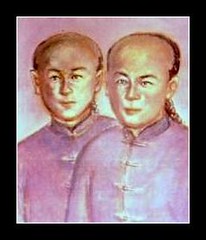
St John Wang Kuixin and his cousin St Joseph Wang Kuiju

Last Monday we celebrated the feast of the martyrs of China – a group of 120 men and women and children who were put to death for their Catholic faith between 1648 and 1930.  With such a large group we might be tempted to forget that each one of these martyrs has a personal story and made an individual decision to choose Christ and the Church knowing that it would mean death.  Among the martyrs are members of families arrested en masse for their faith and put to death in various ways. 

Today is the anniversary of the martyrdom of one of these martyrs, St John Wang Kuixin, whose martyrdom resonates with what is going on in Western society today.

St John was born in Qi County in Hebei Province in the north of China in 1875.  He was a devout Catholic who sought to live his faith as well as he could.  By the age of twenty-five he was married with children, serving his family humbly and passing on the Catholic faith to them.  In 1900 the Boxer rebellion broke out.  The Boxers were a nationalist/religious group who were trying to rid China of foreign influences including Christianity.  A fierce persecution was waging throughout China with countless Catholics being put to death by the Boxers.  Aware of the threat to their families John and his cousin Joseph Wang Kuiju (born 1863), also a fervent Catholic, decided to leave their native village and settle in another one where there was a large Catholic population. 

Loading their meagre possessions on wagons, the cousins and their families had no problem leaving and reached the safety of the other village.  Having left some stuff in their native place, the two cousins returned to collect them.  As they were on their way a heavy shower prevented their continuing the journey, and so they found shelter at an inn.  During a conversation in the inn it was discovered that the cousins were Catholic and the two had to defend their faith as the other guests were attacking their religion.  In the course of the debate, someone sent for the Boxers and as soon as they arrived, they beheaded Joseph on the spot.   John tried to escape, but he was caught and, for some reason, not killed.  He was arrested and brought before a local magistrate.

The magistrate seemed to be a kindly sort and he wanted to spare the young man’s life.  He urged John not to speak about his faith: he should keep it to himself: that way he would not offend anyone and his life would be spared.  But John could not accept such conditions – to hide his faith, to consign it to his “private life” was not what Christ asked his disciples to do.  In fact, for John, to do so was to deny Christ and the faith.  John refused.  With great reluctance, the magistrate handed him over to the Boxers.  On the 14th July 1900 John was put to death, invoking the Holy Name of Jesus as he went to his execution.

John and his cousin Joseph were canonised together by Blessed Pope John Paul II in the year 2000.

St John was asked to do what we are being told to do by our secular governments – to consign our faith to the private sphere and not allow it influence our public words and actions.  Catholic politicians, President John F Kennedy of the USA foremost among them, publicly disavow their Catholic faith and reassure the powers that be that they will not allow their “personal faith” interfere with their decisions.  We have Catholic politicians voting for abortion, civil partnership, gay marriage, euthanasia even though these contradict the moral teaching of the Church in which they claim to be in communion. And then they have the audacity to present themselves as Catholics in good standing and arrive at the altar to receive the Eucharist – and, unfortunately, clergy facilitate this by silence and giving them Holy Communion. 

St John Wang Kuixin’s martyrdom reveals the hypocrisy at the heart of this “double-think” or spiritual schizophrenia.  He also offers us an example of how we should act in the face of secularism’s pressure to make us deny our faith in public and tries to rid the public square of the Christian voice. 

Friday, June 22, 2012

Worthy Patrons Of These Times


What a wonderful feast today:  St John Fisher and St Thomas More, two holy men who died rather than renounce Christ, his Church and the moral law of God.   They are worthy examples and intercessors for us in these times.  A happy feast day to you all, most especially to all our Fraternity members and my blog readers in the UK, and to those in the US as they begin Fortnight for Freedom: may these holy martyrs be with you all and obtain from the Lord the grace and courage we all need to face the challenges of these times.

St John and St Thomas were martyred by Henry VIII because they would not support his divorce, his remarriage and his founding of the Church of England.  But there was another reason too, I believe: both were renowned for their holiness - Henry needed their consent in order to assuage his conscience.  When they refused to give it, then they had to be killed - Henry had to get holiness out of the way because it pricked his conscience.  And as he beheaded them, and murdered the other holy men of England, he managed to silence his conscience.  Our enemies in these times will try to do the same with us.  Stand firm!

Let us remember the lessons of these holy men: no king, president, prime minister, taoiseach or parliament can make right what is wrong in the moral law of God.

Thursday, June 21, 2012

Here We Go...

Well we all knew it was just a matter of time.  Two lesbians in the US are suing a Catholic institution for discrimination because the institution will not recognise their "marriage".   

One of the women is employed by Catholic St Joseph's Medical Centre in Yonkers in New York and she wants her same sex lover to be covered in her medical insurance as her spouse.  The Centre has a policy of not covering same sex partners in their insurance policies, so these ladies are suing the Centre and its insurance company.  Both women will not allow themselves be identified, so they are suing under the names "Jane Roe" and "Jane Doe". 

We all knew that the assurances given to protect religious freedom and beliefs were not worth the paper they were written on.  We will see how this case goes - it will probably go all the way to the US Supreme Court and its ruling will be important in the battle between religious freedom and the homosexual agenda.

We in Europe will need to keep an eye on this - it will be coming to us very soon as various state legislatures are considering changing civil partnerships into marriage.   According to EU law if a state allows gay marriage, then there can be no discrimination, so the Church may find herself in a situation where she will be compelled by law to conduct marriage ceremonies for same sex couples.

So it could be the case that if we priests are not doing time for refusing to break the Seal of Confession, we could be behind bars for refusing to marry homosexual couples.  Marantha!  Come, Lord Jesus! 

Friday, June 15, 2012

Irish Government Goes Ahead With Attack On Religious Freedom


A quick post, breaking my silence during this very busy week.  All going well at the Congress, but we are kept going - my producer is working us hard!    Continuity, interviews, vox pop!  I'm doing introductions in my sleep!   

I see Minister for Justice Alan Shatter is going ahead with his Bill - officially The Criminal Justice (Withholding of Information on Offenses Against Children and Vulnerable Persons) Act, which will make it a criminal offence for a priest not to break the Seal of Confession.  Well, we shall see how things turn out.  For one thing we priests will not break the Seal, end of story: orthodox and dissident priests will be united on that one.  Put us in jail, drag us through the media, we won't do it.  We abhor the abuse of children, but we cannot break the Seal, to do so would violate the sacrament. 

This move is a direct attack on the Catholic faith - it goes against the Constitutional protection to freedom of religion, so if Mr Shatter wants to make a move against a priest he will find himself facing a Constitutional challenge and, listening to some of my friends in legal circles, he will most likely lose.  I personally think the Minister knows this is non runner from the start, I believe he is posing and wants to be seen to be getting back at the Church for her failures.  But to revert to religious persecution: well, Mr Shatter should know better.

One interesting question arises: will the President be able to sign it?  If it offends the Constitution's protection of religious freedom, President Higgins will have to refer it to the Supreme Court to be tested, and it may well be thrown out.  Given that the President is Labour, however, he may not refer it since Labour is pushing this legislation, so it may come down to a challenge should a priest be prosecuted.

William Oddie has an interesting take on it: he welcomes the legislation, believing that it might help in the renewal of the Church.  One commentor in the combox of Oddie's article points out that a priest may be set up - that is true.  Would our government stoop so low?  Probably not.  Would our media?  Well, I'm not so sure there.  Having observed some reporters from the mainstream media (and one in particular), I'm not impressed with them and would expect anything.

Well, time for that novena to St John Nepomuk.  I knew the statue I bought a few years ago would come in handy. 

Saturday, June 9, 2012

A Host Of Witnesses


Many religious Orders and Congregations in Spain number many martyrs.  One of the Orders which suffered the most was the Augustinian.    Ninety-nine friars, one of them a bishop, were martyred for the faith.

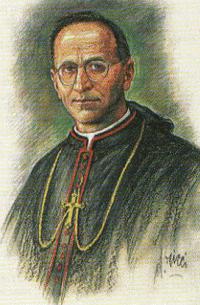
Blessed Anselm Polanco

The bishop was Blessed Anselm Polanco.  He was born in Buenavista de Valdavia, near Palencia on the 16th April 1881.   While still a teenager he joined the Augustinians, making his first profession in 1897.  He was ordained priest in 1904.  Recognising his abilities, his superiors appointed him as a teacher and formator for the friars.  He excelled in the post.  In 1922 he was appointed Prior of the community in Valladolid, and in 1932 appointed Provincial of a province in the Philippines.  This post required a lot of travel, yet in the midst of it all he maintained a simple and prayerful life.  It was while he was provincial that he was appointed the Bishop of Teruel in Spain in 1935, and so he moved back to take up his position.

His time as bishop was destined to be short: the Civil War broke out the following year and Teruel, despite being a small city, was a centre of violence and persecution.  Bishop Anselm made up his mind not to flee, but to stay with his people and try to protect them as the anti-Catholic fury threatened to destroy them.   He managed to do so for a about a year and a half, but he knew that he was living on borrowed time.  On the 8th January 1938 the hour arrived for him. With some of his priests he was arrested by the militia – he left his residence dressed in his Augustinian habit.

Interrogated, the militia tried to force the bishop renounce a letter the bishops of Spain had written denouncing the religious persecution by the Republicans: he refused.  He was imprisoned with his Vicar General and as the war progressed it seemed that they might survive.  However their captors realising that they would soon have to flee themselves, took the bishop out on the 7th February 1939 and shot him at Pont de Molins near Gerona, not far from the border with France.  His Vicar General was martyred with him.  His remains were recovered and laid to rest in his cathedral.  He was beatified on the 1st October 1995.

Blessed Anselm leads a host of Augustinian martyrs – men and women.  Of these the largest group of martyrs come from the community of the Escorial, the royal monastery outside Madrid.  The Escorial was founded both as royal palace with a monastery by King Philip II of Spain.  Dedicated to St Laurence, the deacon and martyr who was born in Spain, the complex was designed to resemble the ancient Temple of Solomon.  The Augustinians took up residence in the monastery section and they ministered in the palace/monastery chapel, the Basilica of St Laurence.

In 1936 the community number 111 friars, some of whom lived outside the monastery in a community in Madrid to facilitate a ministry to university students.    The prior was Fr Angel Custodia Vega (who survived), and it fell to him to protect the community when the Civil War broke out.  Living in such an important symbol of Catholic Spain, the community were quickly garrisoned in July 1936 and lived as virtual prisoners until the 5th August when, as they were praying the chapel, local officials arrived to tell them that they would all be transported to Madrid the following morning. 

Fr Angel suspected what was coming, so he ordered a great feast for the community meal that evening.  The former prior, Fr Juan Monedero spoke during the meal and told the community to be prepared for whatever was to come – things were bad, he said.  The next morning, the community rose early, all the members went to confession and celebrated the Conventual Mass.  Four buses arrived and the friars were taken to a school in Madrid which had been converted into a prison.  The extern friars joined them later, having been arrested in their community house.  Among these was the Provincial himself, Fr Avelino Rodriguez, and the Assistant Superior General of the Order, Fr Mariano Revilla. 

The community tried to maintain a semblance of their religious life, though they were subject to dreadful abuse and blasphemies.  They were offered freedom in exchange for abandoning their faith: not one of them succumbed.

On the 28th and 30th November, the friars were put on trial and found guilty of the crime of being Catholics and friars.  They condemned to death, and the sentence was carried out on Blessed Avelino and Mariano and sixty-five of the El Escorial community.  Among them was a Cuban friar, Blessed Jose Lopez Piteira who was only twenty-three: he was the first native Cuban to be beatified.

These friars were beatified on the 29th October 2007, and with them a number of other Augustinian martyrs.  Ten friars from the community in Udes near Cuenca were martyred: eight on the 24th June 1936 before the Civil War even started, and the last two on the 21st September 1936.  Six friars from Santander were martyred; the friars were running two schools.  From the community in Gijon in Asturias three friars were martyred.  Four friars from the community in Malaga – two priests and two brothers.  And ten elderly and infirm friars who were living in an infirmary in Caudete in Albacete: one of them was executed on the 23rd July 1936, the other nine on the 5th August 1936.

Thursday, June 7, 2012

A True Son Of St Teresa

St. Pedro Poveda Castroverde.jpg

Among the many Catholics who perished in the Spanish Civil War were a number of notable Catholics, one of whom was the renowned Fr Pedro Poveda, the founder of the Teresian Association, shot on the 28th July 1936 in Madrid.  He is also one of the few Civil War martyrs canonised so far.

Fr Pedro was born in Linares on the 3rd December 1874.  Like many other families, the Povedas were devout and Pedro received a profoundly Catholic upbringing.  It came as no surprise to his parents when he expressed a desire to become a priest.  In 1889 he entered the seminary in nearby Jaen, and later transferred to Guadix in Grenada where he completed his studies.  He was ordained on the 17th April 1897.  He continued his studies and graduated with a Licentiate in Theology in 1900.

Fr Pedro began his pastoral ministry in Guadix where he found some of the poorest people in Spain trying to eke out a living.  In the caves outside the town the poorest of the poor made their homes and it was to them that he was drawn.  Helping with their material needs, he also initiated catechism classes, and then founded a school for the children.  Aware of the importance of education for all, he also organised evening classes for the adults.  To help his people he travelled around the province and even went to Madrid seeking alms.   This led to greater attention for his mission, but it was not all positive.

Jealousy raised its ugly head – Fr Pedro selfless work was bearing fruit and some resented this success, and so they began to spread rumours about him.   These rumours and the gossip which resulted reached the ears of his bishop and he began to doubt the priest and his work.  Aware of what was going on, Fr Pedro did not seek to defend himself – he trusted that the truth would emerge eventually: it did not come soon enough and he was forced to leave his beloved poor.

The Dark Night descended on the young priest, but he endured it in faith.  In 1906 the clouds lifted when he was appointed a canon of the Shrine of Our Lady of Covadonga in the north of Spain.  There Our Lady took him under her care as he fulfilled his pastoral duties, got time to study and of course had the space to pray.  This time proved to be providential for it was during the seven years he served at the shrine that he began to develop his system of Christian education as a means of challenging the secularists ideas which were being adopted in the Spanish educational system.  He saw that men and women of faith must play an important role in education and to do so they need to be properly formed and prepared to meet the challenges they might face. 

Publishing articles he shared his ideas with the Catholic world: some understood what he was trying to do, others did not.  In 1911 he founded an academy in Oviedo to provide further education for young women who wanted to be teachers.  Two other academies followed in Linares in 1912 and Jaen in 1913.  In 1914 he took his ideas to Madrid when he founded a university residence for women – the first in Spain.

In 1913 he moved to Jaen where he sought approval from the Church and the civil authorities for his organisation, naming it in honour of St Teresa of Avila, the saint who had inspired him most.  The Teresian Association, under her protection, was to be an organisation inspired by this great woman of letters and faith, and she was presented as model for the members of the Association to imitate.  For the next ten years he worked at building up this new educational family in the Church so that by 1923 it had spread all over Spain. 

Moving to Madrid in 1921, Fr Pedro took up an appointment as Chaplain to the Royal Household – this allowed him to stay in the Archdiocese – the Archbishop had problems with Spanish priests from all over Spain looking to stay in the capital with little to do, so he would not allow priests take up residence and faculties unless they had a decent appointment.  There was no fear of Fr Pedro having too much time on his hands.  He had to deal with a lot of criticism – he was seen as a revolutionary in that his work as he was working with laywomen and forming them to take up their place in the Church.  Nevertheless, sustained by the idea, or indeed the vision, he continued.  In 1924 his Association received approval from Rome – in a symbolic gesture it was the laity of the Association who petitioned the Pope.  The Association was also affiliated with the Order of Discalced Carmelites, a necessary link with St Teresa and a formal recognition that Fr Pedro and the Association are members of that spiritual family.

During these years in Madrid he met St Josemaria Escriva who himself was struggling to get Opus Dei up on its feet.  The two priests understood each other perfectly – both wanted to help the laity to take their place in the Church mission and to realise that they too were called to holiness.  Fr Josemaria found in Fr Pedro the wisdom and experience which helped him understand his own vision. 

By this time Fr Pedro was not only respected as an important educationalist in Spain and founder, but his reputation for holiness was also known.   It also made him a target for the Republicans.  His Association was considered a dangerous organisation by those in the socialist/anarchist movements who sought to use education as a means of bringing the next generation around to their way of thinking.  Like many priests in Madrid, he tried to lie low as the militias were hunting down priests and religious.  On the 28th July he was captured, when asked who he was, he admitted that he was a priest, and he was shot.  He said in the days before his capture and martyrdom: “If we have to die, we have to die, but we die with Christ, in the name of Christ and for the glory of Christ”.

St Pedro was beatified on the 10th October 1993 and canonised by Blessed Pope John Paul II during his Apostolic Visit to Spain, on the 4th May 2003.  St Pedro would be a wonderful intercessor for those who struggle to maintain Catholic schools in the face of the secularising tendencies of governments and various lobby groups.  We will commend our Catholic schools here in Ireland to his prayers, care and protection.

Thursday, May 31, 2012

"Of Course I Am A Catholic!"


Blessed Pier Giorgio Frassati has been called "the most handsome saint in heaven" - he certainly had the looks, and, it seems, the charm, to make him a hit with the ladies.  However, the martyr from the Spanish Civil War whom I will look at today might give Pier Giorgio a run for his money - at least that's what I hear when I listen to young ladies' reaction to the life and personality of Blessed Francisco Castello Aleu.  The old saying "beauty is only skin deep" does not always hold true, for as Francisco was handsome, he was also virtuous, true beauty dwelt within as he sought to live a life of holiness, and service to Christ and his neighbour.

Francisco de Paula Castello i Aleu was born on the 19th April 1914 in Alicante, the third child of his parents.  His father died when he was just a few weeks old, and so his mother was left to raise her three children in difficult circumstances.  Despite this, young Francisco had a happy childhood and was religiously inclined.  After he made his First Holy Communion he went to Mass as often as he could – certainly every Sunday, but a few times during the week also.  While he had an affectionate nature, he had a terrible temper and was inclined to self-love, but he was given the grace to understand these personality flaws at a young age, and so began his struggle to overcome them: here the seeds of holiness were being sown.

When he was thirteen Francisco was sent to the Marists for his secondary education, and while he excelled in his studies, he suddenly faced a spiritual crisis.  While he still continued to go to Mass each Sunday, he stopped receiving the Sacraments, a sad development for a child who had loved the Blessed Eucharist.   Two years later, in 1929, his mother suddenly died: he was distraught, as were his two sisters.  In the throes of shock and sorrow, the three children decided to make a consecration to Our Lady, and this would be the chink of light which gradually brought Francisco back to faith. 

He graduated with his high school diploma with distinction on 14th April 1930, but he was now excelling in another area.  In November of that year he made the Spiritual Exercises of St Ignatius under a Jesuit priest, and this retreat filled him with great joy and strengthened his faith.  He placed himself under the direction of the priest, Fr Galán, and he began to live an intense spiritual life while seeking to put himself at the service of others.

First working for the Parochial Co-operators of Christ the King, Francisco then joined the newly founded Federation of Christian Youth of Catalonia.  With Catholic Action this new organisation sought to catechise young people and engage them in the apostolate of the Church.  Francisco had found his niche, working hard for the organisations, organising retreats and ministering among the young.

Meanwhile he was studying chemistry, graduating in 1934, and then winning a position as an engineer in a chemical fertilizer company on Lleida.  Among the factory workers he found another mission field, organising catechism courses for them and the poor of Lleida. It was a dangerous apostolate as Lleida was well known as an area where anti-clericalism was rife.   

In May 1936 Francisco and his girlfriend Maria Pelegri became engaged.  The two shared a similar spirit of prayer and sought holiness.  In their relationship they had remained chaste, and up to the moment of his death, Francisco could say that he never had anything that needed to be confessed in his relationship with Maria: theirs was a pure love.

The Civil War was by now raging, and on the 1st July Francisco, who had kept far away from politics and the agitation that was going on, was drafted.   He was sent to the fortress in Lleida, but the next day it fell to a Marxist militia.  Francisco was well known for his faith, so it came as no surprise when he was woken up in the middle of the night on the 20th-21st July, branded a facist and taken into custody with a number of others, incarcerated in a old chapel.  Here he remained until the 12th September.  A number of times they tried to persuade him to sign a document renouncing his Catholic faith: he refused.

On the 12th September he was transferred to another prison.  Here he was free enough to get around the cells and comfort other prisoners.  Full of joy and faith, he encouraged them to remain faithful to Christ, led prayers, and helped captive priests.  He managed to get many of his fellow prisoners to go to confession to the priest-prisoners, some reconciling to God after many years of spiritual exile. 

On the 23rd September his passion began.  On that day he endured a difficult interrogation by the communists; after he said to some fellow prisoners: “We will always be 'fascist' prisoners... Let's give up even the glory of martyrdom in the eyes of the world, because since our sacrifice is pleasing to God, nothing else matters!”   His trial took place on the 29th September; he said farewell to his fellow prisoners, made a general confession with a priest, and with joy went to court.  There he was accused of being a fascist, which Francisco denied: he was never involved in politics.   When all their questions failed, his captors finally came to the real crime: “Are you a Catholic?”

Francisco stood up straight and replied: “Yes, of course I am a Catholic!”   The public prosecutor, shocked at the “depravity” of the young man immediately called for the death sentence.  Francisco responded, “If being Catholic is an offense, I am very glad to be an offender, because the greatest happiness that anyone can find in this life is to die for Christ. And if I had a thousand lives, I would give them all for Him, without a moment's hesitation. I thank you therefore for the opportunity you are offering me to ensure my eternal salvation.”  He was then condemned to death.

Taken back to the prison, while his fellow prisoners were sorrowful, Francisco was filled with joy.  Given some time to himself, he wrote last letters to his fiancée whose two brothers had been killed a couple of weeks before, his sisters and aunt, and his spiritual director.  Later in the evening he was taken with five others and put on a truck.  He intoned the Credo, and led the others in singing it.  Brought to a cemetery, the favourite execution spot for the Republicans, Francisco recognised a friend of his sister in the onlookers, a young man. He smiled at him and said farewell.  

Taken into the cemetery, the six were lined up in front of a firing squad.  As the executioners were preparing, Francisco called out “One moment, please! I forgive you all, and I'll meet you in eternity!”  He then joined his hands and raised his eyes to heaven and prayed.    When the commander shouted “Fire!”, Francisco shouted “Long live Christ the King!”  His body was thrown into a grave which had already been dug. 

When the executioners had gone, the sister’s friend crept down into the grave.  He found that Francisco’s heart was still beating, his head tilted to the right, his eyes half open with a serene look on his face.  The young man could not save him, and Francisco was buried – whether he died before or was buried alive we do not know.   He was twenty-two years old.

Francisco was beatified in 2001, and was proclaimed one of the patrons for World Youth Day in Toronto in 2002.

Tuesday, May 29, 2012

Martyr For The Priesthood


Another martyr of the Spanish Civil War today: one of my favorites. 

A few days ago I looked at the life and martyrdom of the Bishop of Barbastro, Blessed Florentino, I mentioned that he was martyred with a gypsy, Blessed Ceferino Jimenez Malla.  Blessed Ceferino was beatified in 1997, and he is the first gypsy to be raised to the altars – he is considered the patron of gypsies and travellers.  Blessed Ceferino’s life, like many of the Spanish martyrs, reveals a man of profound holiness who may well have been beatified for heroic virtue. 

Born in Fraga, near Huesca in the north of Spain on the 26th August 1861, to a gypsy family who worked as cattle traders.  He was formed in the tradition of his family and lived the nomadic lifestyle his people had lived for generations.  Nominally Catholic, the faith meant little to him, and he was more superstitious than religious.   He initially worked as a cattle trader, but later turned his hand to horse trading, and here he made a name for himself.  As a young man he fell in love with his cousin Teresa Jimenez Castro, and they married according to gypsy rites; they settled in Barbastro.

As a man and trader, Ceferino was respected by gypsies and settled people alike.  He was known as “El Pele”, a nickname meaning “Strong One” which was well deserved.   The couple did not have children of their own, but were generous with their relations and always ready to help those in need. 

When in his forties, something began to happen to Ceferino, and he became more aware of the existence and presence of God, and the truth of the Catholic faith.  He began to pray and he realised that his union with Teresa was not regular.  In 1912 when he was fifty-one he and Teresa were married in the Church. Ceferino began to attend Mass, receive Holy Communion and live a full sacramental life.  He learned the Rosary, and was soon never to be seen without it.  With grace building on nature, Ceferino’s natural virtues were intensified as he grew in holiness.   Honest and charitable, he sought to serve others for Christ’s sake.
Soon after his conversion, he and Teresa adopted her niece who had been orphaned: Pepita.   Embracing this little girl, the couple’s desire for a child was fulfilled: Pepita was raised with great love and taught the Christian faith in a home where her adopted parents lived it with generosity and simplicity.

Meanwhile, Ceferino was discovering more and more about his faith.  He could neither read nor write, but this did not stop him learning the truths of the faith, the teachings of the Scriptures and the lives of the Saints.  In his prayer God seem to teach him much, and soon he was offering himself to help the Church in her mission of catechesis: his offer was accepted.  As a catechist he taught the faith to gypsy and settled children alike, and he was adored by them for his simple and pleasant ways. 

In 1922 his beloved Teresa died; he was bereft.  Turning to God, he found consolation in his prayer, and began to intensify his religious observance.  He was freer to be at the service of those in need, and so he became a peacemaker in the midst of his community.  He was sought after as a wise man for advice by people of all ethnic traditions.  When Pepita married, he then had the freedom to be even more generous with his money, and soon he had little, just enough to meet his few needs.  He would eventually have nothing and rely on charity himself, but even then he would give away much of what he received. 

In 1926 Ceferino was professed as a member of the Franciscan Third Order, and he sought to live as radically as possible the life and devotion of St Francis of Assisi.   Like the Poverello of Assisi, he was particularly devoted to the Blessed Sacrament and he spent a lot of time in adoration, eventually becoming a night adorer spending whole nights in the presence of the Blessed Sacrament.

When the Civil War broke out, Ceferino was well known as a holy man.  He was deeply distressed at what was happening, and sought to help priests as much as he could.   In July 1936 when he was in Barbastro, he came upon a situation in which a young priest was being abused by Republicans in the main square.  Ceferino quickly ran to the priest’s defence, but, though a strong man, he was quickly overcome by the militia himself, and he and the priest were arrested.  The two were thrown into prison.  In the cell, Ceferino prayed his Rosary.  When his captors saw the beads they told him to throw them away – he refused, and clutched the beads closer to prevent them taking them away from him: it was this refusal which sealed his fate.

On the 8th August, Ceferino was shot for his Catholic faith, his Rosary beads still in his hand. 

As a priest, the life and example of Blessed Ceferino is very humbling.  Here was a man who put his life at risk to help a priest, and his death came as a result of that very action.  For this, we priests should honour this holy man and give thanks for his deep love of the Church and the priesthood: we have much to learn from him.  In an age when priests face much criticism and even hatred from many (even within the Church) Blessed Ceferino stands as consoling friend and guide to help us keep our eyes on our vocation and our commitment to serve Christ and his Church.

I wonder?  I know St Jean-Marie Vianney is the patron of all priests, it is not unimaginable that Blessed Ceferino could also be considered as a co-patron of priests, seeing as he laid down his life to defend one.