Pages

Showing posts with label St Thomas a Becket. Show all posts

Monday, January 12, 2015

Recommended Reading!


A couple of days ago I finished reading John Guy's biography of St Thomas Becket, simply titled Thomas Becket. It got good reviews when it was first published, and the author has written some fine historical studies including one on St Thomas More's daughter Margaret and one on Mary, Queen of Scots. However, one tends to be careful it comes to secular historians writing about Saints: they may well be historically accurate (not always, by the way), but will they "get" the Saint.

I can say, hand on heart, John Guy "gets" Thomas Becket: the biography is the best I have read on St Thomas and I would strongly recommend your reading it. For one thing it is not a pious hagiography, it situates Thomas in his time and takes Thomas as a man of his time, not condescendingly, but in a real attempt to understand the man as he really was. Guy knows his history and he knows the historical figures who surrounded St Thomas, so if you do read the book you are going to be transported back to the 12th century and your experience will be vivid. The book is well researched, Guy does not rely exclusively on previous publications, but goes right back to the original sources and reads them with an objective eye. St  Thomas emerges out of the legends that surround him (both the negative and positive ones) as a man who was extraordinary, a man whose conversion was not dramatic but gradual, a conversion not from a debauched life but from a distracted life to heroism, to standing for the truth and the liberty of the Church, most of the time standing alone.

Apart from being a great read and an accurate account of one of our great Saints, the book is one which can help us come to understand where we are now because though the events it describes took place in the 12th century they have relevance for us today. The continuing relevance of St Thomas's stand was acknowledged by Henry VIII when he, like his predecessor Henry II, sought to bring the Church under his complete control: the Tudor had the shrine at Canterbury destroyed and the Saint's remains burned. Five hundred years later the rebel Christian Thomas is as potent as he was then.

St Thomas stood for the liberty of the Church. Many previous historians saw his struggle as one in which he sought to keep his wealth, his property, his titles, his life of ease. On a superficial level that is an interpretation one might argue could be applied. However one needs to understand the time and Thomas's motivations. There is no doubt Thomas loved the comfortable life - I won't say life of ease because he was a hard worker and usually found himself in difficult situations which he had deal with, which he usually could. During his exile he found himself living a materially deprived life and he adjusted to that, quite well actually. Thomas fought King Henry II to preserve the rights, laws and liberty of the Church so it could be the Church and not a department of state. It was not material things which Thomas was fighting for, but rather the principle that as a free association the Church had the right to her rights, laws, liberty and yes, possessions, in order to guarantee its freedom from interference by secular rulers. 

Henry wanted to control the Church, deprive the Pope of his role within the Church in England and Henry's possessions in France. Basically he wanted to do what Henry VIII did. Thomas resisted that - the Church had to be free and the members of the Church had to be free in the context of their relationship with the Church. Christ was the only King would could exercise authority in the Church, beneath him was the Pope, the successor of Peter, and beneath him the bishops. Pope and bishops had to defend the flock as well as teach the faith. Henry II would go so far as to think he alone had the authority to govern the Church - revealed in one argument when, as Thomas defended the rights of God, Henry was furious and accused Thomas of depriving him of his rights.  Henry wanted his rights to eclipse the rights of God. He would maintain that he was king by divine right but he developed the opinion that in his kingdom (and his influence over others) meant that he should have greater rights than God: God should, in a sense, bow to what Henry wanted. 

If ever there was antecedent of modern men and women we have it in Henry. Many today disregard God and his laws to satisfy their own desires and enthrone their own opinions. Even in the Church we have pastors who put away the direct teaching of Jesus Christ to replace it with their own ideas which they consider to be more pastoral than Christ's word. This is pride; Henry was full of it; St Thomas, humiliated, impoverished, strong-willed, dogged, stood up to it and refused to yield. Henry was incandescent with rage when Thomas refused to budge, as are many today when a follower of Christ refuses to yield. Thomas was killed for his stance - martyred; today the murder is in the sense of condemnations: of accusations of lacking compassion, of being hard, "unChristian". 

There is another lesson worth taking from the life of St Thomas (there are many): in his struggle Thomas stood alone most of the time. Not even the Pope stood by him in crucial moments. Pope Alexander III was mired in politics, trying to deal with the threats the schismatic Emperor Frederick Barbarossa posed in his campaign throughout Europe. While the pope encouraged Thomas to protect the liberty of the Church, he also urged him to reconcile with Henry as soon and as completely as possible. Thomas knew that could not be done: the only reconciliation Henry would accept was the absolute surrender of the Church to his will, and that could not happen. Pope Alexander would blow hot and cold, at times depriving Thomas of his rights and powers so not to alienate or aggravate Henry, and Thomas bore with this patiently. Part of Thomas's sanctification was that lonely stance when even a pope could not be trusted to hold the line because that pontiff had fears and issues of his own.  As many found to their chagrin (eventually!) Henry could not be trusted, he had no integrity, he was a tyrant and the only way to deal with a tyrant, as Thomas well understood, was to say "No" regardless of the consequences. While many cowered before Henry, churchmen among them, Thomas refused to do so.

In the end, some might say, all ended well. Henry came penitent to Thomas's tomb and apologised in the spirit of their original friendship. Well, things are not as simple as that. First of all Henry and Thomas were not friends, not in the way the legend presents. Thomas may have believed there was a friendship, but he was soon dispossessed of that notion: Henry was king, he had no equals and he used people to get what he wanted - there was no room for genuine friendship in his life. Thomas was a servant, and as long as he was useful Henry was happy to keep him sweet. However, there were things Henry did, mean and awful things, to remind Thomas who was in charge and to keep him in his place.

As regards penitence, Guy is convinced, as I am myself, that there was little or no regret in Henry for Thomas's murder: Henry was brutal and had little regard for justice, mercy or equity - the death of one who refused to yield to him was not to be lamented regardless of how it happened.  Henry's shock over Thomas's murder was, I believe, firmly grounded in the political damage it might cause for him, and he was right to be concerned: even many of Thomas's enemies were won over when they heard of his murder, and Henry was ultimately seen to be responsible for it. The theatrical visit to the tomb in Canterbury in 1174 was purely political, an act of damage limitation - Henry was not a penitent, it was not in his nature. At that stage he had had his wife, Eleanor of Aquitaine, locked up (she would be imprisoned from July 1173 until Henry's death in July 1189 because she had stood up to him), his sons were in revolt and he was facing a long war with King Louis of France. At this stage St Thomas was venerated throughout Europe not only as a martyr and Saint, but as a hero who defended the rights of the poor and dispossessed. Henry was shamed and now he needed good PR. 

However, I wonder if Henry really believed that St Thomas might turn and become an intercessor for his murderer, a tyrant who was intent on getting things back under his absolute control? I have no doubt Thomas was praying for him, but not for his earthly success, for his eternal salvation which, at the end of the day, is the most important thing. We should keep that in mind: we must live and act in a way which will help our salvation, and that gives us an insight into Thomas Becket. A man of the world, in his long-suffering he understood what was most important, and rather than jettison the Word of God to keep an earthly ruler happy, he stood for what was right regardless of the consequences: in the end he had to save his soul and guard the souls of those in his care. That is a good lesson for all of us.

St Thomas Becket, pray for us!

Monday, December 29, 2014

Thomas


This is one of my favourite feasts of the Christmas season - I love them all, but this one, St Thomas a Becket, just seems to have a special resonance for me for some reason. 

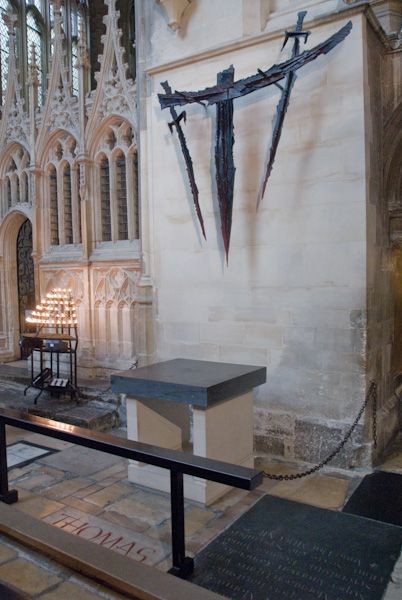
I remember visiting Canterbury Cathedral on this day a number of years ago and spending some time in prayer at the spot where St Thomas was martyred. The cathedral is no longer Catholic, it is divested of its ornaments and the offerings of grateful pilgrims and it is more a museum than a shrine now. A lonely candle marks the spot where the tomb of St Thomas stood, the goal of men and women who walked from all over Europe for centuries. St Thomas's body is missing: some accounts say the monks managed to hide it before Henry VIII's iconoclasts arrived, some suggest the body was burned as were the sacred remains of many Saints in England during the religious revolution.

Some fragments of his relics remain, on the day of my visit I carried a relic of the martyred Archbishop in my hand, a precious gift which I cherish. Other relics are preserved in churches around the world, including the Catholic parish church in Canterbury, now the shrine of the Saint.

St Thomas was an extraordinary man. He was for most of his life a man of the world, an ambitious man who courted royal favour. His efforts succeeded in both temporal and ecclesiastical terms: he was appointed Lord Chancellor of England - the highest office in the kingdom, and then Archbishop of Canterbury, the then Catholic primate of England. He was a friend and companion of King Henry II who conferred offices and favours on Thomas for friendship sake, though Thomas proved to be an able administrator.

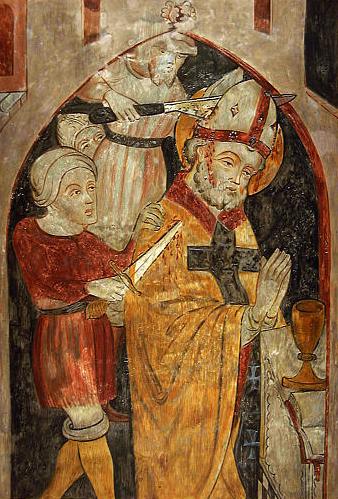
When Henry had him appointed Archbishop he did so in order to have more control over the Church in England. As we know it has often been the desire of secular rulers and governments to control the Church, even today. However this move would backfire on the King, he had forgotten about God and Thomas's faith - though that faith had been hidden away and long neglected.  His ordination as priest and bishop and the realisation of what was being put into his care led to a conversion experience for Thomas and he was forever changed. Now he was no longer the pawn of an ambitious and controlling King, he began to defend the rights and freedom of the Church. He turned to prayer, grew in virtue and practiced mortifications, wearing a hair-shirt under his clothes. We all know what happened: conflict with Henry, exile and eventual martyrdom at the foot of the altar in Canterbury Cathedral on this day in 1170. 

Thomas is a figure of hope for us, one who reassures us that God's grace is at work in us and in all, even in our enemies, calling us all to conversion, fidelity of life and witness to the Gospel. At the end of the day God is in charge, and even if his ministers fail to live up to the Lord's will and commands, God will not fail, he will deliver his people. Wasn't that the message of the Prophets? Wasn't that the teaching of Christ? Our Lord offered his life on the cross so we could be free to live according to the Gospel: his  blood was not shed in vain. At times the blood of his faithful ones will be mingled with his, and that commingling yields great fruitfulness and we are confirmed in our faith, strengthened and encouraged to bear witness ourselves, regardless of the cost.

May St Thomas a Becket, servant of God and his Church, watch over us in these times. Like him may we all be converted to the Lord and bear faithful witness to the Word.

A candle marks the spot of St Thomas's tomb in Canterbury Cathedral

Thursday, December 29, 2011

The Thorn In The Side


What a wonderful feast day today - the feast of St Thomas a Becket, the martyred Archbishop of Canterbury - put to death by King Henry II of England as the two clashed in a battle over the freedom of the Church.  It was a battle which would be repeated five centuries later when another Thomas died in defence of the Church, martyred by another King Henry.

St Thomas a Becket was a man with a past - so we can all find comfort in him and in his conversion.  As we look over the mistakes of our lives, we can be sure that all is not lost, God can still ask great things of us and offer us the graces to respond.  Thomas changed when he achieved high office.  He was ambitious, but when he was appointed to the highest ecclesiastical office in England, the Holy Spirit touched him and he became a humble man and a mighty defender of the Church's freedom. 

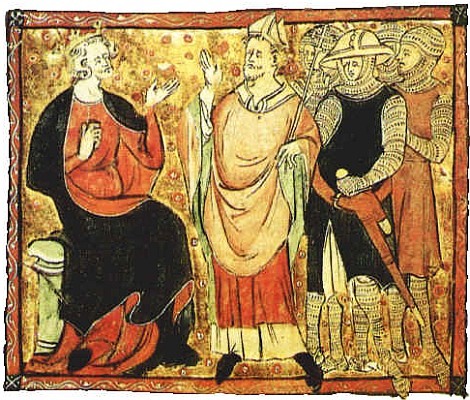
And Thomas was a mighty defender.  He was not afraid to stand up to his former friend, King Henry, who sought to reduce the Church to a department of state.   In fact, Henry had Thomas appointed Archbishop of Canterbury because he wanted to control him.  Henry exiled Thomas for refusing to be a lackie, but instead of isolating the Archbishop, Henry only increased Thomas's credibility and popularity among the faithful.

There is an important lesson in Thomas's life and example for our prelates.  As secular governments try to control the faith of their people, and seek to haul the Catholic Church under its influence, our present prelates need the courage and tenacity of St Thomas to help them resist. 

In Ireland our government is doing its utmost to undermine the Church and perhaps even nurturing the possibility of the emergence of a "national catholic church", another erastian monster to confuse the faithful.   Indeed one of the big state-Church battles is about to break out: that of Catholic education: we need a Thomas a Becket to rise up to help us face the challenge.  May God send us one.

Today I remember with fondness my visits to Canterbury Cathedral to pray at the spot where St Thomas was martyred.  The Saint's tomb no longer exists: though Canterbury was one of the most important shrines in Europe in the Middle Ages, it was destroyed by King Henry VIII.  St Thomas's body has disappeared.  Various stories tell us that either Henry had it destroyed or the priests of the cathedral buried it in a secret place before Henry's soldiers arrived to desecrate it.  There are a few ex ossibus relics of him though, and I was given one when studying in Rome.  On both visits, I walked around the cathedral and prayed holding the relic in my hand and venerating it at the spot where he died.   It will be brought to the faithful of Rathkenny this morning for veneration.

And so, today, let us offer a prayer to St Thomas for our beloved bishops who, like him, seek to govern, guide, protect, teach and sanctify the flock.  Let us remember in particular those bishops who struggle to fulfill the requirements of their office: may the martyred Archbishop lay his gentle hand upon them and assure them of his loving presence and encourage them to heroism.

Wednesday, December 29, 2010

The Martyr Bishop


Fond memories of today's feast, St Thomas a Becket.  A few years ago myself and Fr Owen (he of EWTN fame) went to Canterbury Cathedral on this day to visit the site of St Thomas a Becket's martyrdom.  It would have been our second visit.  When we got to the cathedral Vespers were just finishing and the assembled congregation was dispersing for the warm comfort of their homes (it was a bitterly cold day).  We managed to get a few moments at the "martyrdom", as the spot is called, before being tossed out of the cathedral by a verger (first time I was ever thrown out of an Anglican church).   However, lest you think we had no where to go, we popped into the local hotel to partake of afternoon tea (there too, our second visit).

"The Martyrdom": site of St Thomas's martyrdom

Our first visit had been a year or two before.  On that first visit, as with the second, I brought a relic of St Thomas with me - I had been given a first class relic of the martyr when I was in Rome.  It was a wonderful moment of grace walking around his cathedral, relic in hand, praying and meditating on his life and death.  His body is missing, and has been since the Reformation - hidden by devout monks to save it from desecration by Henry VIII's henchmen.   The relic I had was taken from a piece which has been preserved in Rome since before the Reformation (blows your mind that).  

I have a fondness for St Thomas, he is a wonderful example of priesthood.  He was not always heroic - he was a pretty ambitious character.  He was a friend of King Henry II and the two were carousing buddies.  Henry wanted a pawn in Canterbury in order to control the Church, so when the Archbishop died he had his mate appointed.  However, the Holy Spirit had other plans.  No sooner did Thomas put his unworthy rear end on the throne of See of Canterbury but he changed, and rather dramatically at that.  He realised what God was putting into his care, and was determined to become a trustworthy and valiant shepherd - and he did.  Thomas defended the Church and her people even against the tyranny of his friend.  For his troubles he was exiled and eventually martyred - a heroic model for all priests and bishops.  May he intercede for our pastors in these times, and give them some of the courage he had in defending the Church and proclaiming Christ.
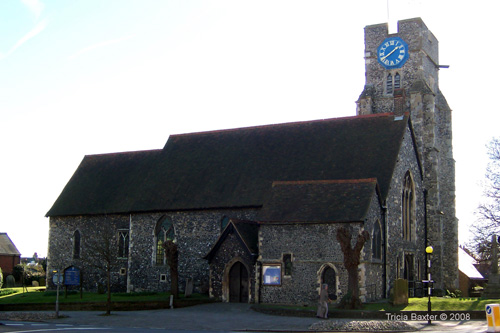
St Dunstan's Anglican church, Canterbury

Canterbury is also the city where the head of St Thomas More is buried.  His daughter, Meg, managed to get her father's head after his execution, and she preserved it until she died: it was buried with her in her husband's family vault which is situated in St Dunstan's Church, Canterbury.  The church, Anglican now, has a lovely shrine to St Thomas, which, to be honest, is a bit ironic and strange given that he was martyred because he refused to reject the Catholic Church and join the new Church of Henry VIII. 


The parallels between St Thomas More and St Thomas a Becket are uncanny: both born in London - both Thomas.  Both become Lord Chancellor of England, both friends of the monarcy - both called Henry.  Both defended the Church from the assault of the monarch and both martyred by the aforesaid king because they would not choose the king and state over God and Church.  Henry VIII was well aware of the parallels - in 1538 he destroyed the shrine of St Thomas a Becket in order to wipe out the memory of the saint's defence of the Church, and try as he could he could not do so, he may have also done so in an attempt to erase the memory of Thomas More- he failed there too.  Martyrs are never forgotten, but grow and become more loved for their heroism.  Secularists please take note.