Pages

Showing posts with label Christmas. Show all posts

Monday, December 16, 2013

Another One....

 
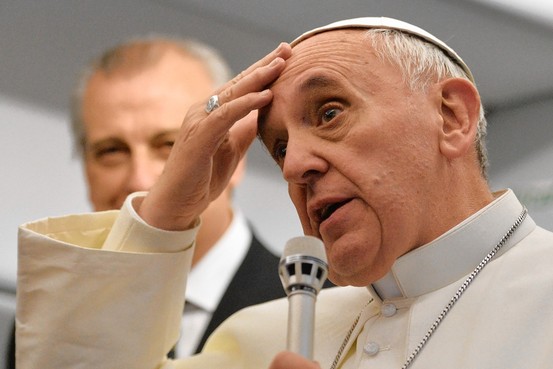
The Pope has given another interview.  I got a text from a friend of mine telling me about it and I could hear the remorseless groan wafting through cyberspace or whatever that thing is that sends texts flying around the world.  But  no need to groan, this is a welcome interview conducted by the reliable Andrea Tornelli, and in it the Holy Father clarifies a number of issues - clarifications which are badly needed and may knock down some resistance to him.
 
 
But in brief:
 
The Pope is not a Marxist, and he believes Marxism is wrong.  Note that he does not say that Marxism is misguided or erroneous: he does not offer a brief rebuttal of Marxist theory, he uses a word that not only says it is incorrect, but also makes a moral judgment of the system.  But, as always, he sees the human beings in the midst of it and he makes a distinction between Marxism and those who follow it, and sees that they can be good people.
 
The Pope is not going to make women cardinals.  That, he said, would be a clericalization of the laity and the clericalization of women.  I hear an echo of Blessed John Paul II's writings on the laity and on women in particular in which he acknowledged the unique and venerable role of the laity: clericalizing the laity is ultimately a denial of the lay state and its place in the mission of the Church.  The way forward is to see how the laity may be incorporated more into the mission of the Church without making them faux-clerics.  Of course I'm not sure if people are aware of this or not, but this will mean a lot more work being put on the shoulders of the laity and that will effect personal and family time.  At the end of the day the mission of the Church is not about power, it is about service, and those who want a greater role in the life of the Church had better get ready to abandon themselves to a greater service: believe me, I know!  And the reality of a life of service is not about self-affirmation and self-fulfilment, it about self-denial and sacrifice - lots of sacrifices.  And perhaps, as the laity take up a greater share of the work it may eventually be seen why God calls certain individuals to a celibate life of total service with no other obligations or responsibilities other than complete availability to service in the Church (with little or no pay!). 
 
It seems the Pope is not in favour of the German bishops's plans to give Communion to the divorced and civilly remarried.  Or at least that is what I discern from his comments on the issue. Francis says clearly: "The exclusion of divorced people who contract a second marriage from communion is not a sanction": it not a punishment imposed by the Church, rather, as Jimmy Aiken correctly points out: "The exclusion is caused by the fact that people who are civilly remarried are not validly married in the eyes of the Church...As a result, unless they are living as brother and sister, they are committing grave sexual sin and it is the grave sexual sin that creates the barrier to receiving Holy Communion."   As I said before, it is a moral issue and the Pope cannot (cannot not won't) change the moral law.  It does not mean we are not to be compassionate or exclude people in these unions from the life of the Church, no, but there is a problem that excludes them from full sacramental participation and that element of exclusion will remain until the problem is resolved.
 
Those issues aside, there is some lovely stuff in the interview, including his reflection on Christmas which I think is worth quoting:
For me Christmas is hope and tenderness...
It is the encounter Jesus. God has always sought out his people, led them, looked after them and promised to be always be close to them. The Book of Deuteronomy says that God walks with us; he takes us by the hand like a father does with his child. This is a beautiful thing. Christmas is God’s meeting with his people. It is also a consolation, a mystery of consolation. Many times after the midnight mass I have spent an hour or so alone in the chapel before celebrating the dawn mass. I experienced a profound feeling of consolation and peace. I remember one night of prayer after a mass in the Astalli residence for refugees in Rome, it was Christmas 1974 I think. For me Christmas has always been about this; contemplating the visit of God to his people.
It speaks of tenderness and hope. When God meets us he tells us two things. The first thing he says is: have hope. God always opens doors, he never closes them. He is the father who opens doors for us. The second thing he says is: don’t be afraid of tenderness. When Christians forget about hope and tenderness they become a cold Church, that loses its sense of direction and is held back by ideologies and worldly attitudes, whereas God’s simplicity tells you: go forward, I am a Father who caresses you. I become fearful when Christians lose hope and the ability to embrace and extend a loving caress to others. Maybe this is why, looking towards the future, I often speak about children and the elderly, about the most defenceless that is. Throughout my life as a priest, going to the parish, I have always sought to transmit this tenderness, particularly to children and the elderly. It does me good and it makes me think of the tenderness God has towards us.
Now that is lovely.  I note the scud against ideology and worldly values.  I think Francis wants all of us see ourselves as the salt of the earth and light of the world, a people who are different, a people who challenge the world through holy lives.  That may well be the key to our survival as Western civilisation collapses under the weight of decadence and greed.
 
And on another issue: Pope Francis is urging greater adherence to the Sacrament of Confession.  He is asking his curial staff to spend time in the confessional in the Church of Santo Spirito in Sassia, the Divine Mercy Church in Rome.  And if he wants more priests hearing confession he certainly wants more Catholics coming to the Sacrament.  I hope all his liberal fans will heed that call.  Let's hope that his admirers in the media will be forming an appropriately repentant queue (with the rest of us!)at the nearest confessional very soon.  I would be more than happy to make myself available to shrive the denizens of RTE and the Irish Times in time for Christmas.  We'll see how the new papalists respond to that invitation!

Sunday, January 6, 2013

Holy Epiphany - Still Christmas!


For many today appears to mark the end of Christmas - the Epiphany, Twelfth Night, yet we still have a week to go:  the Christmas Season lasts until the feast of the Baptism of the Lord, which this year falls on the 13th January.  So we have another week to feast and we can stave off the diet for a little longer, and yes, contrary to common practice, we can still wish each other a "Happy Christmas".  I think the time has come for us Catholics (and all Christians) to resist the secularisation of our feasts and seasons, and the best way to do that is to be true to liturgical time.  The secular world celebrates Christmas before Christmas and then rushes back into ordinary time after the day itself.  We should not rush into Christmas nor rush out of it, but rather linger in preparation (Advent) and then enjoy at leisure the festivities of the Lord's birthday. 

Christmas can be divided into various parts, all of which have a great deal of meaning for us.  We have Advent (the mini Lent) to prepare us, to rekindle the soul (lose a few pounds in anticipation for the feasting!) and reflect on the Jewish people's faithful waiting for the Messiah.  Then the great feast breaks out upon us on Christmas Eve evening and the Day itself which lasts for eight days - the Octave.  This solemnity is so important one calendar day is not enough for its commemoration - we need eight!  So Christmas Day lasts a week in calendar time. 

Then the Season continues as we revel in the birth of the Lord and prepare for his Epiphany.  You could say that as we feast we also accompany the Magi on their way to Bethlehem.  Today we celebrate that great Epiphany as we fall down with the magi before our Infant King, our Divine Messiah.   Then, in the days after Epiphany we may reflect on the Lord's hidden years - the Incarnation in our midst, as we prepare for the feast of the Lord's Baptism and the beginning of his public ministry.  All this time we continue to feast (mince pies, Christmas cake and the turkey curry!).  For the real diehards who just can't let go, we have the "Christmas outpost feast" - the Presentation of the Lord on the 2nd February - our feast of lights, Candlemas.  And then we are all ready for Lent!  Perhaps at that stage, we will need it!

There are people who think we Catholics are killjoys, dreary and no fun at all; well, if Catholics actually entered into the liturgical seasons they would realise that nothing could be further from the truth.  Traditionally Catholics were known for their revels (hence one of the reasons the Protestant reformers broke away from us - they wanted a more penitential approach to faith).  Now there were times when things got out of hand, and that was not good.  However a true living of the Christian faith is one where both fasts and feasts are kept and honoured.  As our Holy Mother Foundress once said: "there is a time for penance and a time for partridge".  Wise words indeed.

And speaking of wise words, today we turn to the wise men, or the Magi and their encounter with the Divine Child.  What an encounter that must have been.  These scholars who spent their lives looking for signs in the sky see the star and are led by it to that Divine Child prophesied by their philosopher Zoroaster.  The Scriptures tell us that they fell down and did the Child homage - they did not discretely bow, nor nod or do the liturgical hop, but rather fell down before him.  Such humility.  And what an insight - they have come to him whom they sought all their lives and they throw themselves before him, worshipping him, perhaps even thanking him.  Our Lady must have been astonished by their devotion - these were pagan men and yet they believed.  We think of the Lord's words about the centurion: "I have not found such faith in Israel" - I wonder, when he said that, if he was thinking of the Magi who came to see him as a baby: no doubt Our Lady, who "pondered all these things in her heart", would have told him of their faith.  Our feast today teaches us than God can work even in pagan lands and in other religions, planting a seed which is to lead the adherents of those religions to Christ.  That is what Vatican II speaks of in its documents.

We too must fall down before him and do him homage: worship and adore Christ.  Yes he became a man to be one with us, to speak to us and redeem us.  But he is also our God and our Lord and we must pay him that homage that is due to him. I remember when I was a seminarian we were told by a liturgist that we must not kneel for the Liturgy of the Eucharist: "We are a liberated people, so we do not kneel, we stand before God".  We are indeed a liberated people, but surely do we not kneel before our Liberator, to thank him if for nothing else?   And when our Liberator is the God who made the universe and us, well, then we must kneel, as do the Elders in the Book of Revelation.  I think the Magi, those wise men of the world provide us with a good example.

On this day our thoughts are, of course, on Bethlehem as we meditate on this event, but we should also pause and go in spirit to Cologne where, we are told, the bodies of three of the Magi are venerated.  Traditionally called Caspar, Melchior and Balthazar, they are honoured as Saints in the Church, and if you go to Cologne you will see the tremendous devotion pilgrims have for these men.   The reliquary in which the relics of the three are preserved is the biggest reliquary in the world, and on this day, it is opened to reveal the three bodies, each one wearing a crown.   All of this points to the Epiphany as a historical reality, as discussed by Pope Benedict in his recent book, and that is no harm at all.  There are times when we need to be reminded that heaven has touched earth, that miracles do happen, that God became man and the story of his birth is no mere fantasy, but wonderful and true.  Some will say only a child would believe such stories, well then, let us be children - after all, as the Lord tells us, the kingdom belongs to little children.  So here we are: back to the humility and faith of the Holy Magi.

St Caspar, St Melchior, St Balthazar, pray for us; bring us to the Divine Child, the King of Love, and there let us fall down before him and adore.

The Reliquary Shrine of the Holy Magi in Cologne Cathedral

The Reliquary opened to reveal the crowned heads of the Magi

Friday, January 6, 2012

A Must for Little Christmas

Okay, I know some will get this and others won't - you have to be a Downton Abbey fan and know the character of Carson the butler.  When I saw this on the web I thought it was hilarious and decided to share it with you: A Very Carson Christmas.

Friday, December 30, 2011

And So This Is Christmas


People are starting to go back to work after the Christmas celebrations.  I believe in the US and other places the Christmas decorations came down on St Stephen's Day (Boxing Day) - what a shame.  Here in Ireland we leave the festive decorations up until the 6th January - traditionally we celebrate the twelve days of Christmas, and the Epiphany is an important feast within those twelve days.  In Ireland Epiphany was known as Oiche Nollaig na mBan (Women's Christmas).

As Catholics it is important for us to celebrate the entire feast of Christmas, from Midnight Mass to the feast of the Baptism of the Lord which brings the Christmas season to an end.  The secular world, devoid of faith and understanding, marks Christmas Day, and then New Year's day as a civil celebration, with the commercial build up and parties that is the sum total of its festivities.  We, however, are only getting into the swing of things when the seculars have dumped the trees into the trash.  Our festivities should be guided by our liturgical calendar, and let's face, the calendar is a real party animal when it comes to the great feasts - seasons and octaves - great stuff!!  These wonderful days of the Octave are the party days, and even after the Octave, we must still keep festivity.  At the end of the day our celebration should be longer and richer!

So now we have the Carol Services, the parties (I had mine on St John's Day) and the feasting.  It is still Christmas, as Stephen Greydanus reminded us a couple of days ago. We keep the crib in place, keep the trees up and the decorations, and, as far as we can, we keep a festive table - no fasting (but no greed either).   And yes, we continue to wish each other a "Happy Christmas" - I notice after Christmas Day people wish each other "Happy New Year" as if Christmas was over.  

Those who criticise our faith tend to regard us as a joyless lot - miserable Catholics.  To be honest, we can be miserable at times, but misery is not Catholic - festivity is - this is what Chesterton reminds us.  St Teresa of Avila tells us that there is a time for fasting and a time for partridge, by which she means feasting.  We must fast well, but also feast well.  So now, we feast. 

Sunday, December 25, 2011

A Blessed Christmas


A Blessed Christmas to all the members of the Fraternity, and all our friends.  May the grace of the Christ Child, born in Bethlehem, be poured out upon you, your families and friends.

On This Most Holy Night

Saturday, December 24, 2011

Happy Birth-day?


As we prepare to celebrate Christmas, we immerse ourselves in those holy texts which foretell the coming of the Christ, then those who lead up to his conception and birth.  Today in our Gospel we read the Canticle of St Zechariah - a wonderful expression of the hope of the people of Israel, and a hymn of joy as that hope is about to be fulfilled in the birth of the Messiah.

It is also a time for us to look over the many traditions associated with the feast - there are so many, and they are so rich.  One of the traditions, we are told, is the date of Christmas itself.  For the last fifty years or so, perhaps more, we have been told that the 25th December is not the date of Christ's actual birth.  I remember in Scripture class being told that the date was worked out from the supposed date of the Lord's death, which early Christians believed to have been the on 25th March.  In the fashion of the ancient Jews, the early Christians took it that a prophet died on the day he was conceived, hence they took it that Jesus was conceived on the 25th March and born nine months later on the 25th December.  But it was all just pious tradition we were told.  We don't know when he was born; indeed, as some Christian theologians might even tell us - he might not have been born at all! 

The other argument they used for the choice of the 25th December was that Christians were Christianising the Roman feast of the Sun god which fell in mid-winter.

Well, as some of you know, there has been some work done on the question of the Lord's birth and the date, and it seems there is evidence that suggests that the early Christians believed that the 25th December was the actual birthday of the Lord.  I will hand you over to Taylor Marshall who has all the evidence, and it is compelling.  Reading over it I am surprised that modern Scripture scholars can just dismiss all of it to maintain what is in reality nothing more than what I call, constructed doubts.

Thankfully the arguments from constructed doubt are being challenged and exposed for what many of them are: a effort to undermine faith and make the teachings of Christianity relative.   Scholarship must also take account of tradition, and indeed common sense.  And the latter has been missing from a lot of scholarship in recent years.  One of the things totally ignored in recent Scriptural research is human relationships: it seems that no one talked to anyone else, that the Apostles and disciples were not actually interested in the Lord's life, they didn't talk to Our Lady or anyone else, and so the accounts we have are all merely symbolic.  Taylor in that article reminds us that the early Christians would have asked questions of Our Lady and those who knew Jesus. 

Christmas is about the birth of Christ, the wonder of the Incarnation.  As we celebrate it this year, we give thanks for the gift of such wonder, a wonder that will bring us to the truth; a wonder that will not allow us dismiss the traditions, but embrace them.  Yes, we seek the truth, but in a manner which is founded on faith and not on constructed doubt.  Yes, yes, I hear you say, constructed doubt is sophisticated, it gives you credibility in the halls of academe and among the elite.  But to be honest, are we not all called to be children?  After all, Jesus was born a baby in a stable, that's the model for the Christian life.

Wednesday, December 21, 2011

Policy Guidelines For A Safe And Ethical Yuletide Season


A friend of mine sent me this: I think it's good, and humour aside, not totally unbelievable.  A little chuckle for the darkest day of the year.

HEALTH & SAFETY POLICIES AND PROCEDURES


WHILE SHEPHERDS WATCHED

While shepherds watched their flocks by night
All seated on the ground,
The Angel of the Lord came down,
And Glory shone around.

The Union of Shepherds has complained that it breaches Health & Safety Regulations to insist the shepherds watch their flocks without appropriate seating arrangements being provided. 

Therefore, benches, stools and orthopedic chairs must be available.  Shepherds have also requested that, due to inclement weather they should watch their flocks via CCTV cameras behind centrally heated shepherd observation huts. 

The Angel of the Lord is reminded that before shining his / her Glory all around, the shepherds must be issued with glasses capable of filtering out any harmful effects of UVA, UVB and Glory lighting.


LITTLE DONKEY

Little donkey, little donkey on the dusty road,
Got to keep on plodding onwards, with your precious load.

The RSPCA has issued strict guidelines with regard to how heavy a load a donkey of small stature is permitted to carry.  Also in the guidelines are permitted feeding breaks, and at least one rest break in a four-hour plodding period. 

Due to the risk of pollution from the dusty road, Mary and Joseph are required to wear facemasks. 

The ‘Little Donkey’ has expressed his discomfort as being labelled ‘Little’ and would prefer to being simply referred to as ‘Mr Donkey’. 

Comments upon his height or otherwise are considered to be a breach of his equine rights.


WE THREE KINGS

We three Kings of Orient are,
Bearing gifts we traverse afar,
Field and fountain,
Moor and Mountain,
Following yonder star.

Whilst the gift of Gold is still considered acceptable – as it may be redeemed at a later date through such organisations such as ‘Cash4Gold’ etc., gifts of Frankincense and Myrrh are not appropriate due to the risk of oils and fragrances causing allergic reactions. An acceptable alternative might be a gift voucher. 

It is not recommended that traversing Kings should rely on star navigation, and would advise the use of AA RouteFinder or Sat Nav.  Both can provide the quickest route and advise on fuel consumption. 

As in the case of Mr. Donkey, the three camels require regular rest and food breaks and facemasks for the three Kings are obligatory due to the likelihood of desert dust disturbed by the camel hooves.
 

THE ROCKING CAROL

Little Jesus sweetly sleep, do not stir,
We will lend a coat of fur,
We will rock you, rock you, rock you,

Fur is no longer appropriate wear for small infants due to the risk of allergy and for ethical reasons.  Therefore, false fur, a cellular blanket or, perhaps, micro-fleece material should be considered alternatives. 

Please note that, only persons who have been subject to a Criminal Records Bureau (CRB) check and have enhanced clearance will be permitted to rock Baby Jesus. 

Persons must carry their CRB disclosure at all times and be prepared to provide three forms of identification before any rocking commences. 
   

JINGLE BELLS

Dashing through the snow on a one-horse open sleigh,
Over fields we go – laughing all the way.

A Risk Assessment must be submitted before an open sleigh is considered safe for members of the public to ride. 

The Risk Assessment should also consider whether the use on only one horse in appropriate – particularly if passengers are of larger proportions. 

Permission from landowners must be gained before entering any ‘Open Fields’. 

To avoid offending those not participating in the venture, it is required that only ‘moderate’ laughter is used and not at a noise level likely to be of nuisance to others.  

RUDOLPH THE RED NOSED REINDEER

Rudolph the red-nosed reindeer, had a very shiny nose,
And if you ever saw it, you would even say it glows,
All of the other reindeer used to laugh and call him names,
They never let poor Rudolph join in any reindeer games.

You are advised that, under the Equal Opportunities Policy, it is inappropriate for persons to make comment upon the ruddiness of Mr. R. Reindeer. 

Name-calling contravenes our Anti-Bullying policy, and further to this, the exclusion of Mr. R. Reindeer from any reindeer games will be considered discriminatory and disciplinary action will be taken against anyone found guilty of this offence. 

A full investigation will be implemented, leading to imposing sanctions such as a ban from hanging up stockings or enjoying Christmas dinner.


AWAY IN A MANGER

Away in a manger – no crib for a bed…

Refer to Social Services immediately!

And, in the bleak mid winter......


That was Holst's version, here is Darke's:

Saturday, December 25, 2010

Christmas Blessings


One of English literature's most beautiful poems is one written by a martyred priest, St Robert Southwell.  This poem, The Burning Babe is one which inspires me a great deal because it is a work of great hope.  We all need hope in these times, a hope not rooted in the world, or in individuals or great ideas; rather, a hope which is rooted in the Lord of hope himself, Christ our Saviour. 

Many have lost their faith, many in the last year as scandals have worn away the confidence of many, and yet not even the greatest scandal or the greatest tragedy can erase Christ, his message and his sacrifice.  Christ was a victim himself, but instead of abandoning the truth, he proclaimed it because he was the Truth, the Way and the Life.

This is true hope, and in this holy season, we can ask for an increase of this hope through an increase of the gift of faith.  In the poem St Robert, shivering in the cold, a man pursued for his faith, a holy priest tormented for his faithful ministry, a servant of Christ who would shed his blood for Christ, as Christ shed his blood for him, and for all of us.    Listening attentively to the Child of the vision, St Robert's heart is glowing, and he is encouraged by what he hears.  The Child laments that people have closed themselves to him, and yet he wishes to warm them with his divine fire, bring them back to life with his love.  This is the Lord's timeless message, and he calls on us to listen to him. If we do, we will discover true hope, and the fire he will enkindle within us will give us confidence, peace and joy - the very things our world needs in these times.

THE BURNING BABE.
by St Robert Southwell

AS I in hoary winter’s night 
  Stood shivering in the snow, 
Surprised I was with sudden heat 
  Which made my heart to glow; 
And lifting up a fearful eye         
  To view what fire was near, 
A pretty babe all burning bright 
  Did in the air appear; 
Who, scorchèd with excessive heat, 
  Such floods of tears did shed,         
As though His floods should quench His flames, 
  Which with His tears were bred: 
‘Alas!’ quoth He, ‘but newly born 
  In fiery heats I fry, 
Yet none approach to warm their hearts         
  Or feel my fire but I! 
 
‘My faultless breast the furnace is; 
  The fuel, wounding thorns; 
Love is the fire, and sighs the smoke; 
  The ashes, shames and scorns;         
The fuel Justice layeth on, 
  And Mercy blows the coals, 
The metal in this furnace wrought 
  Are men’s defilèd souls: 
For which, as now on fire I am         
  To work them to their good, 
So will I melt into a bath, 
  To wash them in my blood.’ 
With this He vanish’d out of sight 
  And swiftly shrunk away,         
And straight I callèd unto mind 
  That it was Christmas Day.

On behalf of the Council of the Fraternity, I would like to wish all our members and friends every blessing and grace this Christmas, and a peaceful New Year.

Friday, December 24, 2010

The Pope's Reflection


Busy here at the moment, as you would expect.  A few stolen moments to share with you, on this Christmas Eve, the reflection the Holy Father gave on BBC radio this morning.  It just sums it all up - so beautiful.

Recalling with great fondness my four-day visit to the United Kingdom last September, I am glad to have the opportunity to greet you once again, and indeed to greet listeners everywhere as we prepare to celebrate the birth of Christ. Our thoughts turn back to a moment in history when God's chosen people, the children of Israel, were living in intense expectation. They were waiting for the Messiah that God had promised to send, and they pictured him as a great leader who would rescue them from foreign domination and restore their freedom.

God is always faithful to his promises, but he often surprises us in the way he fulfils them. The child that was born in Bethlehem did indeed bring liberation, but not only for the people of that time and place - he was to be the Saviour of all people throughout the world and throughout history. And it was not a political liberation that he brought, achieved through military means: rather, Christ destroyed death for ever and restored life by means of his shameful death on the Cross. And while he was born in poverty and obscurity, far from the centres of earthly power, he was none other than the Son of God. Out of love for us he took upon himself our human condition, our fragility, our vulnerability, and he opened up for us the path that leads to the fullness of life, to a share in the life of God himself. As we ponder this great mystery in our hearts this Christmas, let us give thanks to God for his goodness to us, and let us joyfully proclaim to those around us the good news that God offers us freedom from wwhatever weighs us down: he gives us hope, he brings us life.

Dear Friends from Scotland, England, Wales and indeed every part of the English-speaking world, I want you to know that I keep all of you very much in my prayers during this Holy Season. I pray for your families, for your children, for those who are sick, and for those who are going through any form of hardship at this time. I pray especially for the elderly and for those who are approaching the end of their days. I ask Christ, the light of the nations, to dispel whatever darkness there may be in your lives and to grant to every one of you the grace of a peaceful joyful Christmas. May God bless all of you!