Pages

Showing posts with label suffering. Show all posts

Wednesday, May 22, 2013

Not Just For The Desperate

 
St Rita of Cascia is often invoked for "impossible situations" - when Anthony has not earned his fiver, or Jude has too many desperate cases on his books, people turn to Rita, the patron of impossible cases.  Now Catholic devotional history can be quirky at times, and yes it has been known to verge into the realm of the mad, the strange and the downright heretical.  So great care must be taken to keep us on the right road.
 
The first thing to note on the feast of St Rita is that it is God who answers our prayers - the Saints make intercession for us, and that intercession is most welcome for our lives, as is their friendship, their example and their writings.  Saints do have particular patronages, and we should indeed invoke the various Saints under their patronages, but we must be careful not to think that one Saint can trump another when it comes our requests.  God may well grant a request when a particular Saint is invoked rather than when another is invoked, but this is because God wants us to look at that Saint for a particular reason - for their example or for a lesson.
 
St Rita teaches us many lessons, one of the most important being endurance in faith.  She had her troubles, and what troubles!  An unhappy marriage, wayward children, opposition to her vocation, and then when she finally became a religious other problems emerged through her mystical life.  Yet in spite of it all she never lost her faith in God, nor stopped striving to love him more.  In this fidelity and love, she was sanctified.  Rita is indeed a Saint to invoke when we find ourselves with difficulties we may think are impossible to overcome. Rita reminds us that for God all things are possible, and if we put our trust in Christ we will be not be confounded and we will be delivered.  That is good news for today.
 
There are many beautiful stories too from St Rita's life - the story of the bees will appeal to the more ecological among us - how the bees gathered around her cradle after her birth and became a sign of the sweetness of the holiness which would mark her life.  The story of the twig is also lovely - how a twig she planted in the ground began to grow and became a vine which to this day produces grapes - that is most certainly a sign whose meaning we find in St John's Gospel.  
 
Her stigmata has attracted attention - instead of wounds in her hands, feet and side, she bore a single wound on her forehead, a wound from the crown of thorns.  This wound led to her isolation within the community because of its odour - some of the sisters could not cope with the smell, so Rita spent most, if not all her time, in her cell.  Often, those who are united to Christ and endure his suffering find themselves alone in the world either through misunderstanding, fear or even hatred.  St Rita teaches us that despite this, we should cling to Christ all the more and never stop loving our brothers and sisters regardless of how they treat us.  In reality, the more we conform to Christ, the more the world becomes suspicious of us.  Despite her isolation in the community because of the wound, Rita was still loved and her sanctity was obvious. Her suffering gained many graces for the sisters in her community and for those who asked her prayers: as followers of Christ we must always remember that suffering bears fruit, much fruit.
 
Today I greet all my Augustinian friends! St Rita is one of their great Saints, and as a true daughter of St Augustine and St Monica, she reveals in her life, both in the ordinary events of that life and the mystical, how to follow the Lord.  Like Augustine her heart was aflame with love and she sought to set others on fire with that love.  I pray today that her Augustinian brothers and sisters will continue to set hearts on fire with love for God; to help people remain faithful to Christ and his Church, and in the spirit of St Augustine, to explain those teachings which are often rejected by many but within which we find the way to true happiness.  Happy feast day to them all!
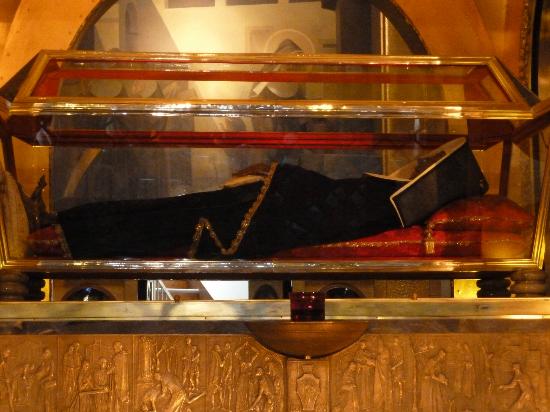
 
The body of St Rita exposed for veneration at her shrine in Cascia

Wednesday, November 7, 2012

The Suffering Pontiff


News from Rome seems to confirm that Pope Paul VI may well be beatified next year: the Congregation for the Causes of Saints is examining a possible miracle.  He has yet to be declared Venerable, but once that decree is signed and the miracle accepted, beatification can quickly follow.  If Pope John Paul I's cause is as advanced, Pope Benedict may well make history by beatifying his three immediate predecessors - Paul VI, John Paul I and John Paul II.    

Pope Paul's beatification may well prove to be controversial - I imagine there are many of a certain generation who will be appalled.  And perhaps some of our more Traditionalist Catholics will not be impressed either.   

Paul's legacy is a mixed one and he was a complex man.   He was a holy man, I think few would doubt his personal holiness.  But for all of that his pontificate is controversial and perhaps even seen to be divisive. Some maintain he was a weak man unable to control the fall out from Vatican II, others see him as a liberal intent on changing the Church radically.  And of course there are those who reject his teaching on artificial contraception and see him as a man who, in the end, turned against the "spirit of Vatican II".   This last view may well be the thing to raise the ire of some in the Church should he be beatified. 

Whatever position people may take, I think Paul's stance on the issue of artificial contraception may well have been the work for which he was called to be Pope.  Despite the urgings of the committee Blessed John XXIII set up, and the attempts of various Church figures to influence him, Paul saw he could not change the moral teaching of the Church, but rather had to reiterate it even though it meant becoming a pariah.  It was surely a case of Paulus contra mundum: doing what he saw was the right thing though the world and many Catholics, now gripped in revolution, could neither accept nor understand.  With the promulgation of Humanae Vitae, Paul's via crucis began in earnest and he became what I believe to be "the suffering Pontiff".

My view of the last few popes is simple.  I believe the Ven. Pius XII prepared the Church through his own engagement with the world and fight against tyranny, for a great reform.  Blessed John XXIII was called to initiate that reform with the calling of the Council.  Pope Paul VI was to suffer in the turbulence of the post-conciliar period for the reform.  John Paul I was sent to reveal, after years of trouble and division, the gentleness and humanity of Christ - the "smiling pope" was just to be there, though only for a short time, to bring a certain peace.  Then John Paul II, the great charismatic one, brought the Council back on track: he stabilised, taught, drew people back in and went out to the world to proclaim Christ and promulgate the New Evangelisation which is the fruit of Vatican II when that Council is properly understood.  And then there is Benedict the Teacher who, in his gentle way, teaches those John Paul II brought back and prepares the members of the Church to go out to the whole world and proclaim the Good News.  He teaches, consolidates, puts us back in touch with the tradition (the ressourcement of the Council): reminds us that we already have a solid foundation on which to build our new missionary effort.  And the next Pope?  A missionary?  A defender of the faith in a secular world where civilisation is crumbling?  I do not know, nor will I speculate - the Holy Spirit is in charge there.

Is that all too simplistic?  Perhaps, but I do see a plan, a divine plan, where each of our recent popes were called to fulfill a certain role in these times.  Paul was the one called to suffer - they all suffered of course, but Paul's own suffering seemed to mirror the confusion and craziness of the times.  His suffering was inflicted by the disobedience of Catholics who rebelled against the Church's teaching because they thought they had a deeper insight into their humanity and into how things should be. 

Did Paul make mistakes?  Yes, I believe he did: for example he should have upheld the suspension of the Washington priests who rejected Humanae Vitae.  In reinstating them he sent a dangerous message to all those who dissented: rebel and nothing will be done to you.  But Paul wanted to bring them around, and while in hindsight we see that did not work, hindsight is a wonderful thing.  Paul was not a disciplinarian, he wanted to persuade, to encourage people to see the truth and accept it: he had pure intentions, I believe.

In related news I see that a Cause has been opened for Aldo Moro, the former Prime Minister of Italy and personal friend of Pope Paul, who was murdered by radical socialists in 1978.  Moro was a noble man who, with Paul's help, saw his role as a politician in terms of a call from God to serve his people.  His faith was important to him and he may well have been a saint - time and the process will tell.  His murder left Paul devastated and most likely hastened the Pontiff's death: Paul died a few months later.  One of the saddest images of Paul is from the funeral of Aldo Moro in St John Lateran's.  Paul, broken and burdened with grief and suffering is carried into the basilica to preside over the funeral Mass.  In his homily, Paul asks God why this good man had been so brutally torn from his family and friends and killed in such an inhuman way.  That homily is one of the most extraordinary ever delivered by a Pope: indeed, it is one in which the Pontiff seems to rebuke God:
And who can listen to our lament, if not you, O God of life and death? You did not hearken to our supplication for the safety of Aldo Moro, this good, meek, wise, innocent and friendly man; but you, O Lord, have not abandoned his immortal spirit, sealed by faith in Christ, who is the resurrection and the life.
Blessed John Paul deeply admired Pope Paul: they were friends, and Paul turned to the then Archbishop of Krakow as he was writing Humanae Vitae.  In one of his speeches about Pope Paul, Blessed John Paul praised his legacy and his courage:
A strong and humble apostle...Paul VI wanted the ecclesial community to open up to the world without giving in to the spirit of the world. With prudent wisdom, he knew how to resist the temptation of ‘conforming’ to the modern mentality, sustaining difficulties and misunderstandings, and sometimes even hostility, with evangelical strength. Even in the most difficult moments he did not cease to bring God's illuminating word to his people.
Paul's beatification will, I think, bring us to focus on his legacy, his teaching and his courage.  It will also be an opportunity for the Church to explain what Paul actually teaches in Humanae Vitae, this time with evidence.  Paul was a prophet - what he said might happen should we abandon the moral law of God, has happened: it may well be time that the world woke up and saw reality for what it is.

Wednesday, September 14, 2011

Triumph Of The Holy Cross


At this Mass this morning, for the feast of the Holy Cross, we had veneration of a relic of the True Cross.  It was a most moving ceremony because all of us know what the cross is like, to some extent, in our lives.  In these difficult times it seems the shadow of the cross has fallen on Ireland and we must carry it in the midst of many trials and much bitterness

That, however, is the call of the disciple of Christ; Jesus tells us we must take up our cross and follow him if we wish to be his disciples.  When Jesus said these words his followers must have been shocked - for them the cross was a horrible method of execution, one which symbolised not only terrible suffering and disgrace, but one which also signified damnation (A curse on him who hangs on a tree: Deut 21:23, Gal 3:13).  They would have been at a loss to figure out why Jesus said this: they understood later after the crucifixion and resurrection.  But for them it signified something awful and indeed for many when the cross comes it is awful, so we need to look at it and see Christ himself.  That is why we Catholics leave the figure of Christ on the cross - when we look at a crucifix our eyes are drawn to the One who hangs upon it and so we do not feel that we are alone - we are there with Jesus - he is with us. 

I love this feast because it is so rich - and consoling.  I have always been fascinated with the story of St Helena heading off to the Holy Land when in her late seventies/early eighties to look for the Holy Places and relics.  She must have been one great lady.  She had it tough in life, she knew what the cross was like, so perhaps this made her strong and kept her active at what then would have been a very advanced age.  Her husband divorced her to marry the daughter of the emperor and improve his chances of getting the Imperial throne for himself.  Constantine her son, however, did not forget her and made her Augusta (empress) when he won the throne, but I imagine he was a tough cookie and Helena may have had her own problems with him: perhaps there was a Monica-Augustine dynamic there too.   Some Christian traditions regard Constantine as a saint. 

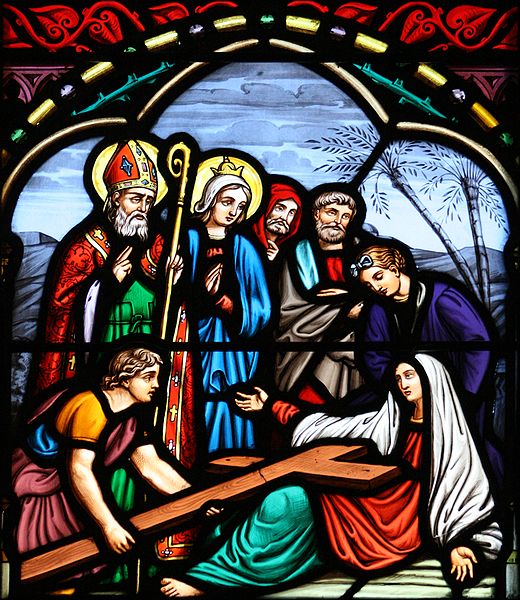
Contrary to what some say, today's feast does not commemorate the finding of the cross - that event was marked by another feast on the old calendar on May 3rd.  This feast today originally commemorated the rescue of the relic of the True Cross once preserved in Jerusalem, but carried off as booty by Persian forces in the 7th century.  The recovery of the relic reminded the Church of the victory Christ won for us on the cross, and so this feast, the Exultation of the Holy Cross was instituted.  Blessed Pope John XXIII combined the two feasts into one in 1960.