Pages

Showing posts with label G.K. Chesterton. Show all posts

Friday, June 12, 2015

Tea With Winston, Dinner With Gilbert


I am back blogging after a bit of a break. Some friends were wondering why the silence. Well, being a priest in a parish makes many demands and they have kept me busy. I am also using some blogging time to catch up on my reading. I am a bookworm, but of late I have been finding it hard to get some reading in and that is not good for me, nor for any of us. We should all be reading, spiritual books of course, but also others to keep us informed.

At the moment I am reading Roy Jenkins's biography of Winston Churchill. It is a fine book. Churchill, as many of you know is an interesting character. As an Irishman, I suppose there is the expectation to dislike  him, but I cannot conform to that: I do actually like him. Now he was not a perfect man, he had his flaws, many of them as do all of us. One of his friends once said that in first meeting Winston all his flaws are all too apparent, but after that one spends a lifetime getting acquainted with his virtues. For all the flaws and ambition, he was a good man who wanted to do something great for his country (and get the glory!).  And what a writer he was! I have been eyeing up his books in the bookstore, his life of Marlborough looks interesting and his volumes on the two World Wars are all too like a honey trap which would wile away weeks and months.

Reading the biography I find myself wondering what he would make of the world today. He was a member of the liberals, and when a Conservative he was a member of the liberal wing: liberalism then was very different to what passes as liberalism today. For one thing he believed in the monarchy and one of his great, failed (and unwise) campaigns was to keep India in the empire, for reasons that were conservative to the core. He also opposed Irish independence for much the same reasons, though the pragmatist in him saw him relent and become a supporter of the Free State during the Civil War here. It is interesting to note that he befriended Michael Collins whose guerrilla warfare did much to drive the British to the negotiating table. Churchill was wise enough to see what Hitler was up to as many in the British government at the time nurtured fantasies of appeasement in the hope of peace. I wonder what Winston would say about IS? Would be dismiss them or see a growing threat?

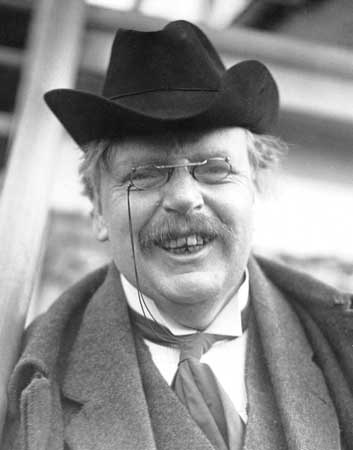
So I think afternoon tea with Winston might have been an interesting experience. Not dinner: you couldn't afford to feed Churchill - he was not the most abstemious of people. Champagne with every dinner? No, no, no. I would have dinner with Chesterton, he would eat enough but as long as it was common fare and he had a few ales he would be as happy as Larry. Besides, Chesterton's conversation would be much more stimulating. You have to listen to Churchill and be fascinated and entertained, but Gilbert would draw you into conversation, perhaps debate, certainly entertain you, edify you, make you laugh, and then end it all with a prayer before he put on the coat and sauntered out to figure out how to get home.

Another literary figure I am spending a little time with (when time allows!) is Flannery O'Connor. She is a fascinating figure, a little like Chesterton, but darker - like Dante in that respect. As those of you who have read her will know she is concerned with grace: as one critic said, she explores the work of grace in a world governed by the devil. That reason alone means she is necessary reading for us today. I also think, like Chesterton, she was a saint, not a plaster one, but a real flesh and blood woman whose faith transformed her life and her suffering while deeply informing her writing. I would love to see her and Gilbert canonised one day; forget Oscar Romero and Co - Flannery and Gilbert are the real revolutionaries. And what companions for us today: their writings can inform and challenge us, their lives inspire us, and, I hope, their intercession can assist us. 

Heaven is going to be great. We will have the vision of God, the embrace of the Blessed Mother, but then the company of so many wonderful people. We must work hard for heaven! 

Wednesday, November 19, 2014

Saints, Miracles And The Question Of Gilbert's Weight

The only known photograph of the Ven. Matt Talbot

It is not uncommon when waiting for a bus in Dublin that, after what seemed like an eternity standing at the bus stop (usually in the rain), more than one bus arrives at the same time. It is a phenomenon which may well be common in other cities too, but in Dublin it leads one to conclude that the city is so dangerous even the buses go around in packs. Anyway it seems this phenomenon may well be happening with regard to our candidates for Sainthood. Last week Fr John Sullivan was declared Venerable and work begins on getting a miracle approved for him, and now it seems there may well be a miracle for the Venerable Matt Talbot in the US (details here). Let's hope we see both Irishmen raised to the altars soon; we could do with some good news.  

Among the other Irish causes is that of the Forty-Two Martyrs, the Servant of God Richard Creagh and Companions, Ultimately martyr causes should be easy enough, do the work and submit it to the Congregation, no miracle is required for beatification just the decision that the candidates are genuine martyrs. I am told that as soon as these martyrs are beatified, they will be joined to the other Blessed Irish Martyrs and submitted as a single cause for canonisation. However, I sense the will is lacking in all of this and these Servants of God may well remain in limbo. 

I don't mean to be negative, but as you know I think Saints are important for the faithful and local Saints and Beati can help a local Church in a myriad of ways. I usually hear talk  of "priorities" in the "Irish Church" and these causes can be dealt with when other more important issues are dealt with (in that case they will never be dealt with because, it seems, there are always other, more pressing matters). We have plenty of ability and talent in the Church here in Ireland, most of it untapped, processing these causes need not interrupt Irish Church officials from dealing with other matters deemed to be more important. Anyway, I'll get off the soapbox, rant over.  

Regarding causes I note an article on G. K. Chesterton's cause and the difficulties it may face: in a nutshell - his weight. Steven Drummel at Catholic Household reflects on this and sees trouble ahead, the question of the virtue of temperance may well block the Cause, or at least that is what is being considered.  Jennifer Pierce over at Crisis Magazine is also considering the question and she situates the issue on whether or not Gilbert was a glutton. There will be a hot debate over this. Drummel cites the examples of two fat saints, Thomas Aquinas and John XXIII. He says that Aquinas was not as corpulent as images show him to be, one would wonder then why he was depicted as such and why the table had to be adapted for him in one of the priories (Note to self: consult Dominican friend on this). John XXIII is also excused, it seems, he ate very little Drummel tells us. I have heard that John XXIII liked his ice cream a lot, and even considered it a martyrdom to eat it - he found it difficult to give it up.

Anyway we shall see where it all goes. Saints are human, they have foibles and that makes them endearing and somehow more human to us. Such foibles can also offer a contrast in which we see the person's sanctity even clearer. I will continue to pray for Chesterton's cause and I would encourage you to do the same if you can. And read him!

Thursday, March 6, 2014

Not Your Average Saint


Is there such thing as an average Saint?  I suppose for many Saints are distant figures; people the Church has put on pedestals to intercede for us and to admire as those who achieve heroic virtue and sanctity in their lives on earth and now reap their reward in glory in heaven.  However, as I constantly remind my parishioners, they are not remote figures at all.  They were flesh and blood men and women like us, who faced many of the same difficulties that we do, but they often responded in ways that were more graced: graced, yes, but easier, no.  For them sin and temptation was as real as they are for us; the trials of life took their toll on them too.  Yet they abandoned themselves to God and strove hard to overcome these difficulties. 

In this Lenten season the prospect of Sainthood is put before all of us. The reason for this season is holiness - this is our annual retreat when we take stock of our lives in a more radical way and see that each one of us is called to heroic virtue, to great sanctity.  As Blessed John Paul II reminds us: holiness is God's plan for us, and the ordinary way of living for a Christian.  The trials and difficulties of life are the means through which we are sanctified, and we meet these with an ardent life of prayer, a radical renunciation of all that which hampers God's work in us and with a daily offering of ourselves to God so his will may be done in us. The road to holiness can often be a lonely road, but we do meet others along the way, some walking in the same direction, others trying to test us, and of course the ones whom we are meant to assist for Christ's sake, and for their own, so to perfect charity within us.

As we reflect on this we must also remember that those who have gone before us, the Saints, were all different and unique people, and sanctity manifests itself in different ways in each of them.  We have the obviously mystical and we have those who slogged their way through life with not such much as glimpse of a vision.  We have the gentle and patient, and then we have those who did not suffer fools gladly, like St Pio who was as famous for his gruff ways as his holiness.  We have people from every walk of life, and of every age; from those who lived long lives to those who lived very short ones. Many of these Saints lived in ordinary places doing apparently ordinary things and their heroism emerged there, others found themselves in the midst of turbulence, persecution and history's most traumatic moments and their holiness was formed in heroic deeds.  There is a Saint whose life mirrors yours.

For your Lenten reading today, I suggest an article from The Catholic Herald on G. K. Chesterton. There is an investigation going on at the moment to see if a Cause should opened for him.  Many of us are convinced that he should be canonised, but sometimes Mother Church and her leaders tend to take the long road on making decisions on whether to open a Cause or not.  Some would suggest they are taking the scenic route on this one.  Prudence, I suppose.  This article is good because it explains that Chesterton does not fit the mould of a conventional Saint (maybe that is why things are progressing slowly).  But then again, as I have said, there is no such thing as conventional holiness. If I may be Chestertonian for moment: holiness is wild, untamed, radical, unconventional - it is by its very nature heroic, and there is nothing common or conventional about heroism. Holiness breaks moulds, not fit into them, nor even make them.  Each Saint is unique in his or her holiness, they emerge from the crowd not slip behind it.  And let's face it, no one would ever accuse Chesterton of slipping quietly behind the crowd, he was no shrinking violet.  And perhaps it is for that reason, for his sheer (and perhaps even shocking) unconventionality that he is well placed to remind us all that we too are called to be Saints. 

So, as Chesterton would say, this Lent, let us begin the great adventure.